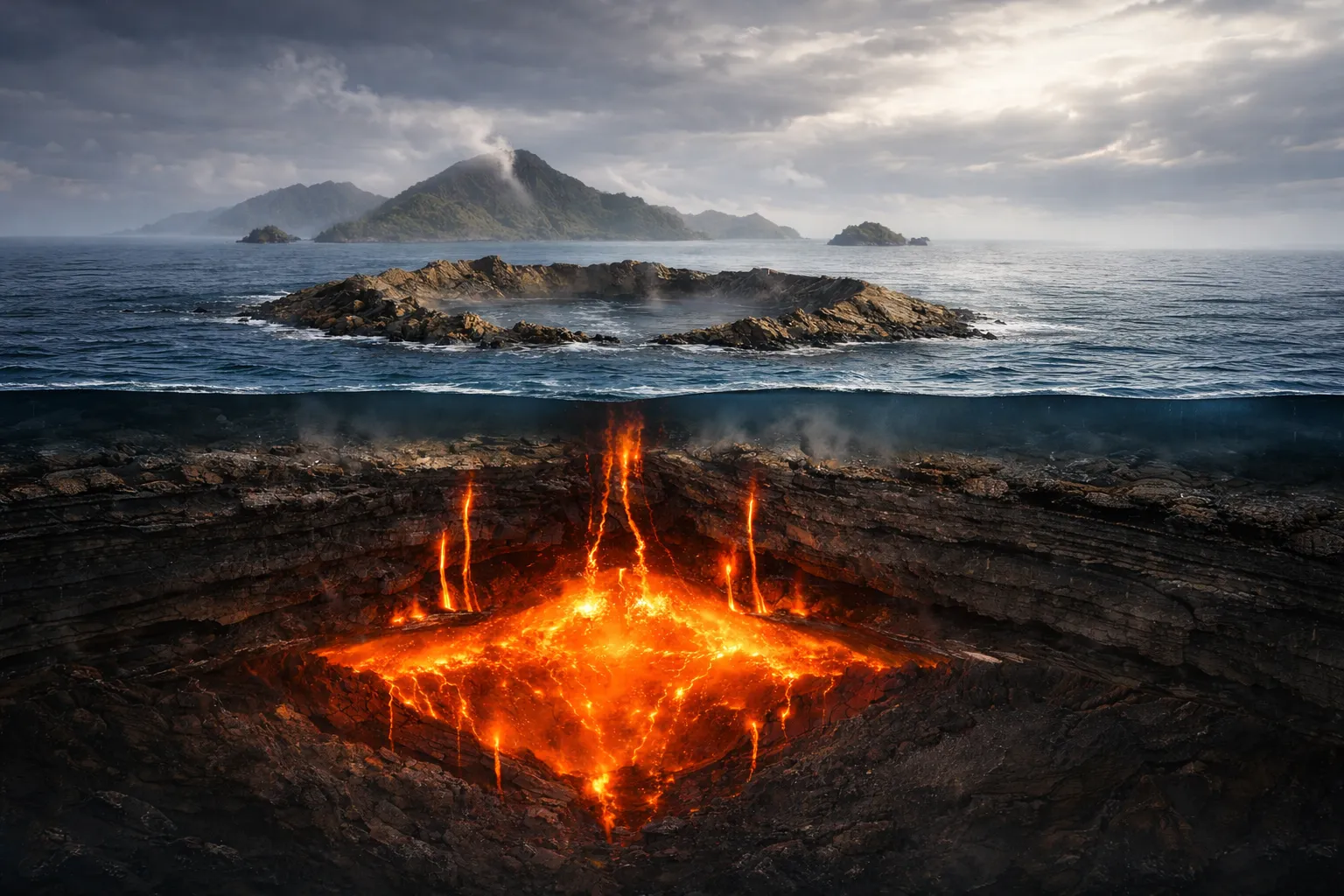
A volcano that was mostly hidden under the sea off the southern coast of Japan erupted about 7,300 years ago. The eruption was so strong that it changed the whole area. Pyroclastic flows blasted outward at a terrible speed, crossing more than 80 kilometers of open ocean to reach Kyushu's southern tip. Volcanic ash fell over an area larger than 2.8 million square kilometers, from Hokkaido in the north to the Korean Peninsula in the south. In terms of geology, it gets a 7 on the Volcanic Explosivity Index. This is one of the most powerful eruptions of the Holocene, which is the 11,700-year period we live in. The Jōmon people who lived there at the time were a hunting and gathering society that already made pottery, and they were just swept away.
The Kikai Caldera, a mostly underwater double crater in Japan's Ōsumi archipelago that is about 20 by 17 kilometers wide, was the source. When the eruption was over, it left behind between 332 and 457 cubic kilometers of volcanic material spread out over a wide area. To put it another way, there was enough material to bury all of Central Park under 12 kilometers of debris. The parts of the original building that were still standing fell into the sea. The Kikai-Akahoya eruption, which is its official name, is the biggest eruption that has happened in the current geological epoch.
Researchers at Kobe University have now published results in Communications Earth & Environment that show the magma reservoir under Kikai seems to be refilling. This has been happening for thousands of years already.
What the Seismic Data Showed
It is not easy to study a mostly underwater caldera, but the research team, which included geophysicist Nobukazu Seama and co-authors Akihiro Nagaya, Gou Fujie, Satoru Tanaka, Hiroko Sugioka, and Shuichi Kodaira, used the underwater setting to their advantage. Seama's observation is straightforward: "The underwater location enables us to conduct systematic, large-scale surveys." On land, it is hard to set up large-scale seismic grids because of roads, private property, and the terrain. The limits go away when you're in the water.
The team worked with the Japan Agency for Marine-Earth Science and Technology (JAMSTEC) to make controlled seismic pulses with airgun arrays and put ocean-bottom seismometers all over the seafloor to see how those sound waves moved through the crust below the caldera. This is a well-known method. The speed at which seismic waves move through rock depends on what the rock is made of and, most importantly, whether there is molten material present. Magma makes them go slower. A region of unusually low seismic velocity is a good sign of melt.
They found a big, low-speed anomaly right under the old caldera, between 2.5 and 6 kilometers below the seafloor. Seama was clear: "Because of its size and location, it's clear that this is the same magma reservoir as the last eruption." The reservoir is the same size and shape as the system that caused the Kikai-Akahoya disaster thousands of years ago.
Not Old Leftovers, but New Magma
The most important part of the finding is not just that magma is down there. Where it came from is what matters.
A small pocket of magma left over from an eruption 7,300 years ago that is slowly cooling in the dark would not be very interesting. What scientists discovered instead narrates a fundamentally different account. Researchers had already seen that a new lava dome has been forming at the center of the caldera for the past 3,900 years in earlier surveys. That alone shows that the volcano is still active. But a chemical analysis of the material from this younger dome and other recent volcanic activity shows that it is very different from the rhyolitic magma that caused the terrible eruption in the past. The chemistry isn't right. Seama concluded, "This means that the magma that is now in the magma reservoir under the lava dome is probably magma that has just been injected."
The implication is important. Kikai is not a broken system that is slowly cooling down. It is a system that has been getting new inputs from depth, adding new melt to the same structural reservoir that once fueled one of the most violent eruptions in human history. The researchers call the process "melt re-injection," and they put their findings into a model they call the Magma Re-injection Model. This model shows how deep-sourced magma rises into a shallow reservoir, builds up over time, and—under the right conditions and over geological timescales—could cause a big eruption in the future.
A common trait among the world's most dangerous volcanoes
There are other buildings with this style besides Kikai.
The Yellowstone caldera in Wyoming is about 3 to 8 kilometers deep and sits on top of a magma reservoir. This depth range is very similar to Kikai's shape. More than 640,000 years ago, Yellowstone erupted in a way that caused a lot of damage. However, the system is still one of the most closely watched in the world. Toba in Sumatra is the site of what is thought to be the biggest eruption in the last two million years. There is also evidence of a large, shallow magma system still in place beneath the caldera. Santorini in Greece, whose eruption in the Bronze Age around 1600 BCE probably caused problems for Minoan civilization, has a similar structure. I find this coming together very interesting. These volcanoes are not just dangerous; they seem to have a common design, with a shallow reservoir that stays full of magma coming from deeper sources.
Seama said it clearly: "This magma re-injection model fits with the idea that there are large, shallow magma reservoirs under other giant calderas, such as Yellowstone and Toba." The fact that Kikai has less liquid magma than Yellowstone right now does not make it any less important. For monitoring, the pattern itself is what matters. If re-injection is a normal part of the lifecycle of these systems, scientists need to figure out not if it happens, but how quickly it is happening and what signals come before any possible eruption.
That's exactly what Seama's team wants to do. "We want to improve the methods that have worked so well in this study so that we can learn more about the re-injection processes," he said. "Our main goal is to be able to better keep an eye on the important signs of future giant eruptions."
In the last 10,000 years, there have been at least 27 confirmed volcanic events in the Kikai Caldera. These events range from small ash eruptions to the terrible Akahoya event. The Japan Meteorological Agency kept it at alert level 2 until February 2026 because there was still low-level unrest at the Iwo-dake summit. That doesn't mean an eruption is coming soon. "Refilling" can mean thousands to tens of thousands of years of slow accumulation on geological timescales before any threshold is reached, if one ever is.
This research addresses a persistent deficiency in our comprehension of supervolcano behavior. For many years, the most common way of thinking about giant caldera eruptions was that they were one-time disasters followed by slow deaths. Kikai changes that. The reservoir didn't go away. It stayed the same, and it is being filled up from below. It turns out that supervolcanoes don't just die. They go through a long, slow recharge cycle, and for the first time, scientists are able to see it in enough detail to understand how it works.