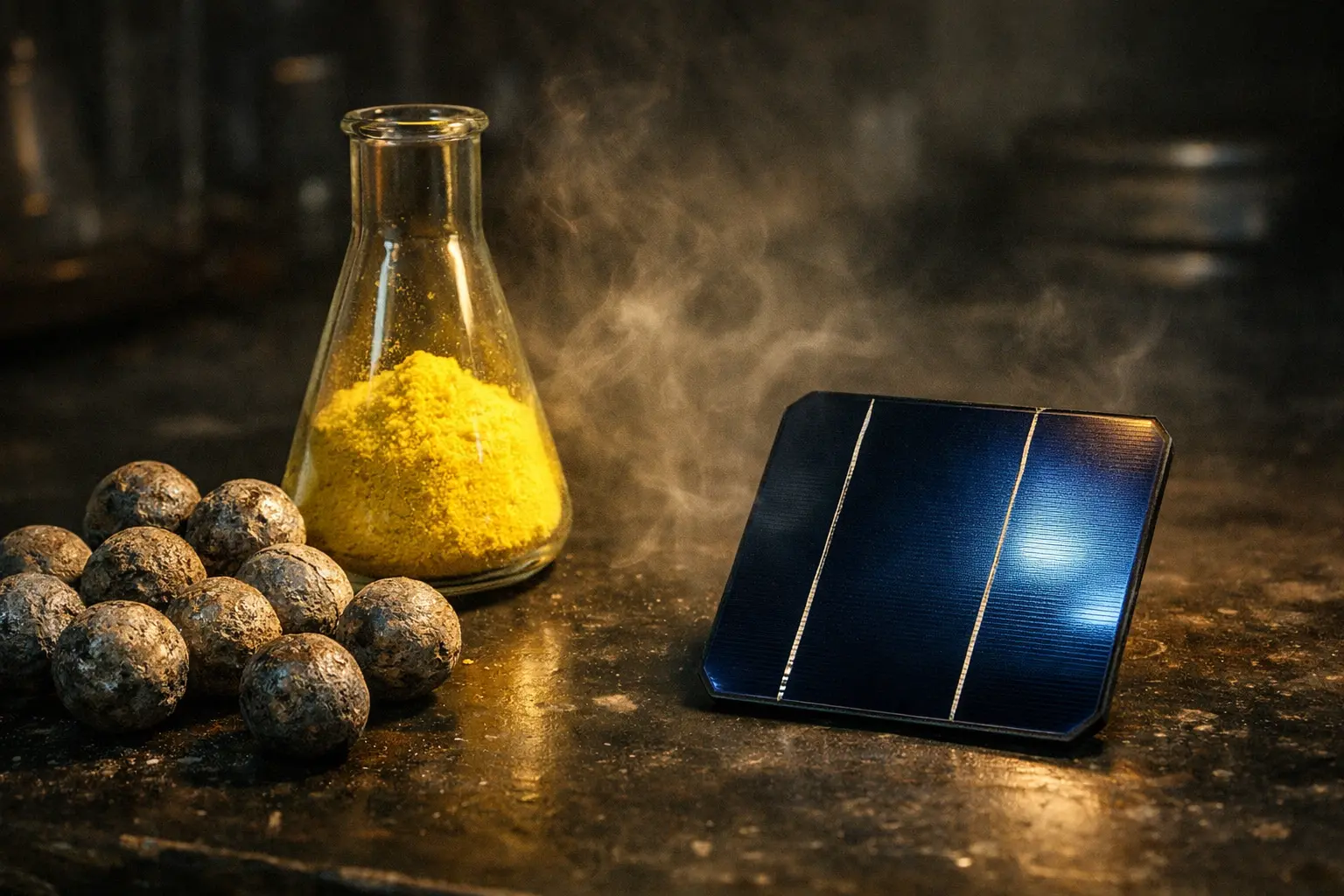
Somewhere in a laboratory in Erlangen, a physicist is dropping corroded lead spheres into a flask. The spheres are roughly 300 years old. They were once loaded into matchlock muskets and arquebuses, fired across European battlefields, and then lost to the soil. The researcher bought them on eBay.
What happens next is genuinely strange. The bullets are rinsed in nitric acid, melted, and cast into rods. Those rods become the electrodes in a non-aqueous electrochemical cell that strips lead atoms off the metal and marries them to iodine. The product, a yellow powder of lead iodide, is then crystallized and dropped into a formamidinium-based perovskite solar cell that converts sunlight to electricity at around 21 percent efficiency. That is a figure indistinguishable, statistically, from cells made using freshly mined, commercial-grade precursors of 99.999 percent purity.
The team, led by Mykhailo Sytnyk and Ian Marius Peters at Forschungszentrum Jülich’s Helmholtz Institute Erlangen-Nürnberg for Renewable Energies, published the work in March in Cell Reports Physical Science. The headline is novelty. The substance underneath is a proof about the future of a solar technology that, for all its promise, carries a toxic secret that has long made serious people nervous.
A technology that eats lead
Perovskite solar cells are the most exciting thing to happen to photovoltaics in three decades. In roughly fifteen years they have gone from a laboratory curiosity with sub-four-percent efficiency to certified single-junction devices above 26 percent and tandem cells, where a perovskite layer sits atop a silicon base, that have blown past the old silicon ceiling. In April 2025, the Chinese manufacturer LONGi recorded a 34.85 percent efficiency on a perovskite-silicon tandem cell, certified by the US National Renewable Energy Laboratory. Oxford PV, the British-German spinout that built the world’s first commercial perovskite module in Brandenburg, shipped its first 24.5 percent modules to a US utility customer in September 2024 and announced a 28.6 percent commercial cell earlier this year. Four Chinese start-ups are already selling perovskite panels by the megawatt. The technology is no longer a possibility. It is arriving.
The problem is that the best-performing perovskites, the ones setting those records, are built around lead. Specifically, they require lead iodide, PbI₂, as a precursor. Researchers have tried tin and other substitutes for more than a decade. None have come close. As Tonio Buonassisi, who runs MIT’s Photovoltaics Research Laboratory, put it in 2022, lead-based devices have kept improving while the others stalled. Lead is also cheap, abundant, and electronically forgiving in ways competing metals are not.
A single square meter of perovskite module contains only a gram or two of lead, which sounds trivial. Scale that to the terawatt deployments climate scenarios require, and the arithmetic changes. You need industrial quantities of lead iodide, and you need it at what the industry calls five-nines purity. Mining it is dirty, expensive, and exposes miners and smelter workers to one of the most thoroughly documented neurotoxins in medicine.
Why bullets
The world already has enormous quantities of lead in circulation. Around six million tonnes are consumed globally each year, over 85 percent of it going into lead-acid batteries. The recycling story there is a good one, at least on paper. In the United States and most of the European Union, more than 99 percent of spent lead-acid batteries are collected and the lead recovered. In poorer countries the picture is uglier, with informal smelters exposing workers and children to lethal doses, but the lead itself rarely goes missing. It gets melted down and reborn.
Other lead streams are not so tidy. Ammunition accounts for perhaps three percent of US lead consumption. Hunting pellets and shot disperse across forests and wetlands. Electronic waste, construction debris, old cable sheathing, pigments, plumbing solder. The authors of the Cell Reports study estimate that 30 to 40 percent of lead waste is effectively abandoned at end-of-life, scattered in forms and locations that make recovery uneconomic. Millions of tonnes.
Peters and his colleagues wanted a feedstock nobody in their right mind would choose. They needed something visibly degraded, chemically filthy, wildly non-uniform. Centuries-old musket balls fit the brief perfectly. They came with carbon residue from black powder, layers of oxidation built up over generations in soil, and the usual metallic hitchhikers you find in period ammunition: copper, silver, zinc, and traces of antimony. If a process could handle that, the argument ran, it could handle almost anything industry throws at it.
So Peters bought a batch on eBay. In the paper this appears, with academic understatement, as an “exceptionally challenging model feedstock.”
The chemistry, and why it matters
The conventional route to making pure lead iodide is wet. You dissolve lead in nitric acid, producing lead nitrate, then add an iodide source to precipitate PbI₂.. The trouble is that inert old lead resists acid attack unevenly, impurities co-precipitate, and the water chemistry introduces hydroxide ions that later haunt the perovskite by catalysing its degradation. Every gain in one column becomes a loss in another.
The Jülich team pivoted. Their first step is non-aqueous electrochemistry. The bullet-derived lead rods sit in acetonitrile, an organic solvent, with dissolved iodine as the electrolyte. Apply a current, and metallic lead oxidizes directly to PbI₂ at the electrode surface. They report a Faradaic efficiency of around 94 percent, which in practical terms means almost every electron the team pushed through the circuit did what it was supposed to do. Process optimization delivered yields 204 percent higher than initial attempts. No wastewater treatment. No hydroxide carryover. The solvents used are hazardous in their own way and have to be managed as organic waste, but the researchers argue that closed-loop distillation and recovery, standard in the chemical industry, would keep the footprint small.
That first step still leaves the powder carrying traces of copper, silver, and zinc from the original bullets. Modern solar panels are unforgiving. A few parts per million of the wrong impurity, particularly calcium or bismuth, will seed deep-level traps inside the perovskite and destroy its electronic performance.
The second step is a purification technique called inverse temperature crystallization, or ITC. The team dissolves the crude PbI₂ along with formamidinium iodide in gamma-butyrolactone, another organic solvent, and then, counter-intuitively, heats the solution. Certain perovskite compounds become less soluble as temperature rises. Large, well-ordered single crystals of formamidinium lead iodide grow out of the warm liquid, and as they grow, they physically exclude the unwanted metal atoms, which stay behind in the mother liquor. The crystals that come out the other side meet the five-nines standard the solar industry demands.
From there, it is ordinary perovskite device fabrication. Spin-coat the precursor onto a substrate, build up the stack, measure the efficiency. The devices tested produced power at roughly 21 percent conversion, matching control cells built from pristine commercial lead iodide. Not a record. Just identical to the best the industry can do, from the worst material the researchers could find.
The point is not the bullet. The point is that if the method handles a degraded matchlock projectile, it handles your battery-smelter tailings, your demolished-building solder, and your printed-circuit-board ash. The authors are explicit that they see this as a route to capture the missing 30 percent, the lead that currently leaks out of the industrial cycle and into ecosystems and landfills.
Peters has written on LinkedIn that the devices built from the bullets are statistically indistinguishable from those made with commercial 5N precursors and that toxic legacy waste can become a resource for clean energy. The language is less breathless than most science communication, which is appropriate. The experiment is careful rather than spectacular.
There is a deeper point about perovskites that this paper quietly makes. Silicon solar panels are difficult to recycle because every layer is fused into a single laminated structure designed to last twenty-five years. When they die, they usually die in a landfill. Perovskites, because they are deposited from solution, can be taken apart the same way they are put together, layer by layer, with the right solvent. Last year the Jülich group published a separate paper in Energy and Environmental Science showing they could recover up to 99.97 percent of the materials in a working perovskite cell using layer-by-layer solvent extraction, and other groups at Linköping University and Cornell have demonstrated aqueous processes that reuse components up to five times with no loss of efficiency. A life-cycle assessment by Tian and colleagues suggested that properly recycled perovskite modules could cut energy payback time by roughly 73 percent and greenhouse emissions by 71 percent compared to virgin production, figures that would put recycled perovskites ahead of even silicon on climate metrics.
Put the two ideas together, recycled input and recyclable output, and you start to see the outlines of a genuinely circular photovoltaic industry. One where the lead that frightens regulators is lead that never entered a mine and never leaves the loop.
A historical footnote, and a working answer to a real problem
There is something almost theological about the image. A lead ball cast three hundred years ago, fired from a matchlock across a field in the Thirty Years’ War or one of the succession wars that followed, sits in a Saxon field for centuries. Someone digs it up, lists it on eBay, and a physicist in Erlangen turns it into a crystal that makes electricity from the sun. The alchemists of the period these bullets were fired in believed you could transmute base metals into gold. They were wrong about the metal, right about the aspiration.
But the seriousness of the Jülich work is not the poetry. It is that perovskite photovoltaics face a regulatory crunch they have not yet resolved. Every proposed large-scale deployment of lead-containing modules runs into a version of the same question: where does the lead go, and what happens when a panel cracks on a rooftop or is dumped at end-of-life? Manufacturers have answers involving encapsulation and leakage testing. Regulators are not fully persuaded. Some jurisdictions may refuse to license large-scale perovskite installations until the end-to-end lead balance is demonstrably benign.
A process that lets you feed the most contaminated lead waste on Earth into the front of the factory and produce five-nines material at the back substantially changes the calculation. Not because the amount of lead in a panel goes down, but because the lead never leaves the anthropogenic cycle. It goes from ammunition to photovoltaic crystal to, with any luck, another photovoltaic crystal after the first one dies.
Whether this particular chemistry scales to industrial throughput remains to be proved. The paper flags the obvious bottlenecks: electrode passivation during long runs, mass transport in large cells, and solvent losses. These are engineering problems rather than physics problems, the kind that chemical companies solve for a living when the market signal is clear.
The signal is getting clearer. Oxford PV has a gigawatt-scale plant under development. Chinese firms are ramping past the hundred-megawatt pilot stage. Qcells has passed IEC and UL certification on 28.6 percent of cells and plans commercial production in 2026. The demand for high-purity lead iodide is going to climb sharply through the next decade, and the industry will need a defensible answer to where that lead comes from.
Mining more of it from ore bodies in Peru or Kazakhstan is one answer. Pulling it out of battery smelter tailings; electronic waste; old construction debris; and yes, the occasional consignment of 17th-century musket balls purchased from an online auction is another. The German experiment suggests the second answer is not only possible but also, for the purity levels solar panels need, perhaps easier than the first.
Somewhere a metallurgist three centuries ago cast a sphere of lead and sold it to an army. The army fired it, probably missed, and moved on. The sphere sat in a field while empires rose and fell and monarchies gave way to republics and two world wars came and went. And then, last year, a physicist bought it for a few euros, dissolved its surface in acid, melted the rest, and made sunlight into electricity.
It is, in its small way, an answer to a question that has hung over the climate transition for years: whether the dirtiest parts of the old economy can be turned into the cleanest parts of the new one. The honest answer has always been that most cannot. This one can.