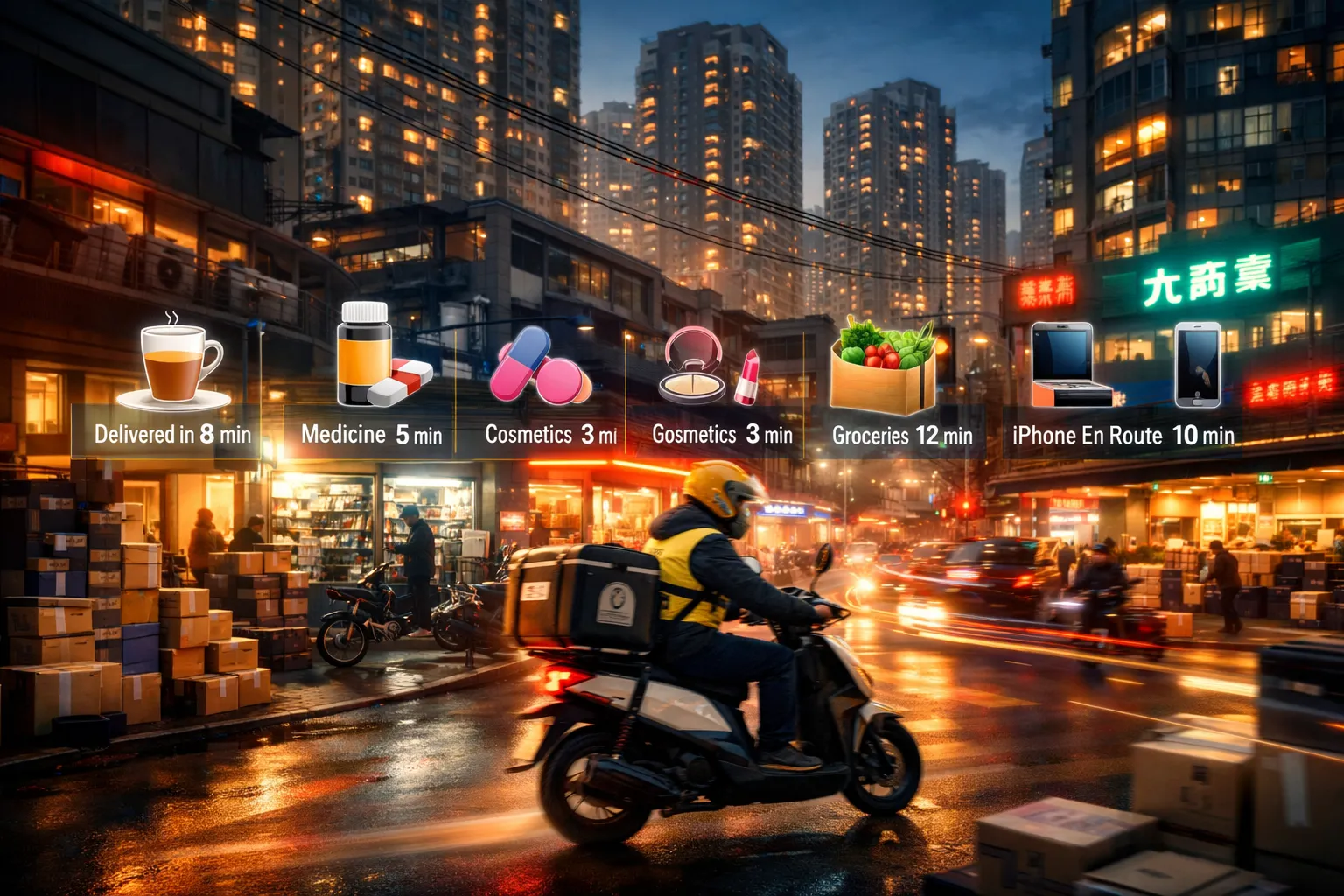
You can get your coffee delivered to your office before you get there by tapping your phone quickly on the way to work. Are you ready for a night out? You can get a new shade of foundation in less than 30 minutes. If you wake up at 2 a.m. with a sick child, medicine will be there in a few minutes. No pharmacy run. No waiting.
In China's quickly growing model called the "30-minute economy," instant retail, or hyper-delivery, this is what life is like. It started out as an improvement on the old way of delivering food, but it has long since broken free of that original container. It now has almost everything a customer could want, like a soldering pen for a broken appliance, an iPhone, an air conditioner, pet food, and insulin. A person who lives in Beijing's Chaoyang district recently found this out when a small light on an appliance stopped working. He used a food delivery app to find the mini electric soldering pen he needed at a nearby store. He had it in his hands in less than 30 minutes. He didn't know you could do that. The first time, most people are surprised.
China is far ahead in this change, but other markets are also moving quickly in this direction. In March 2026, Amazon started offering one-hour and three-hour delivery options in hundreds of U.S. cities for more than 90,000 items. Walmart has quietly passed Amazon in same-day grocery delivery by turning its 4,700 stores into local fulfillment centers and working with DoorDash, Spark, and Uber to handle the last mile. In the third quarter of 2025, DoorDash processed 776 million orders, which was a 21% increase from the previous year. The total value of all the orders was $25 billion. These numbers are real. There is a race. But none of it is as big as what China has built.
The Size of What China Has Built
According to MoonFox Data, China's instant retail sector was worth 780 billion yuan, or about $109 billion, in 2024. In that same year, China had more than 60 billion instant delivery orders for the first time, a 25% increase from 2023. The Chinese Academy of International Trade and Economic Cooperation, which is part of the Ministry of Commerce, says that sales will reach 1 trillion yuan ($140 billion) by 2025. This is more than three times the rate of growth of China's overall e-commerce sector, which is growing at about 9% a year.
The 2030 estimate of 2 trillion yuan ($274 billion) is not just a guess. It is based on changes that are already set in stone, like the density of people living in cities, the infrastructure for mobile payments, an AI-driven logistics backbone, and a generation of shoppers who don't even think about where a product is before they buy it.
In the summer of 2025, when it was at its busiest, Meituan, Alibaba, and JD together were filling more than 230 million instant retail orders every day. On July 12, 2025, Meituan alone got 150 million instant retail orders in one day. Two days later, Taobao Flash Sales and Ele from Alibaba said they had more than 80 million daily orders, with more than 13 million of those being for things other than food. These numbers are shocking, even for China, and they were partly caused by aggressive platform subsidies. But the demand that is driving it is not fake.
Three businesses have set up the market. Meituan has the biggest share, with 760 million registered users on its platform and what is now officially called Meituan Flash Buy. JD.com, which spent years building its own supply chain and logistics infrastructure, launched "JD Instant Delivery" as its main service in 2024 and officially entered the food delivery business in 2025, promising full social insurance coverage to its delivery riders right away. This shocked the industry. Alibaba runs Ele.me and the grocery store chain Freshippo (Hema). They have combined the two into a single instant retail system that got 60 million orders on sale days.
Grocery and staple goods make up just over half of the market by volume, but the categories that are growing the fastest tell a more interesting story. There is a big rise in electronics, baby products, beauty products, healthcare items, and clothing. In 2024, Meituan's orders for consumer electronics were almost 40% of JD.com's total. This is impressive for a platform that started as a restaurant delivery service. Instant retail platforms have added major brands like Huawei, Xiaomi, Midea, Decathlon, and MINISO. This is a clear sign that this is no longer a niche convenience channel. In 2024, fast-moving consumer goods companies moved 35% of their digital advertising budget to instant commerce. This was up from 18% the year before.
The Infrastructure That Makes It Fast
The promise of 30 minutes does not come true. It needs a completely different physical and computational setup than regular retail or even e-commerce that ships the next day.
The "flash warehouse," also known as a dark store or lightning warehouse (闪电仓), is the most important part of this system. These are small distribution centers built for a specific purpose and located within three to five kilometers of densely populated areas. They don't have a store, signs, or staff who deal with customers. Every square meter is set up to make picking orders faster. Most of the time, each warehouse serves customers who live within 3 to 5 kilometers of it. By the second quarter of 2025, Meituan had built more than 50,000 of them across China and planned to build 100,000 more by 2027. Dark store clusters located near big residential areas cut fulfillment costs by 30 to 40% compared to traditional retail models. They also cut average delivery time to less than 15 minutes in busy urban areas.
AI takes care of the logistics layer. Dispatch algorithms send orders to the closest warehouse, assign riders based on the location and volume of the order, and keep track of inventory so that it doesn't run out. Meituan's system has an 85% availability rate for daily necessities, while traditional retail only has about 60%. JD Logistics has expanded its "local-warehouse" model to smaller cities, cutting delivery times from two days to the same day for more than 85% of SKUs. This increased daily order volumes by 20% in those markets.
The model has also changed what it means to be a retail business. Sam's Club, Walmart's membership store in China, only has about 50 physical stores in the country. In 2024, it processed more than 400,000 online orders every day and made over 100 billion yuan ($13.7 billion) in sales each year. It did this by turning each store into a fulfillment center that could deliver the same day within a six-kilometer radius. Costco opened its first store in Shanghai in 2019. By 2024, it was making an estimated 10 billion yuan with only seven stores. The size of the store doesn't really matter. The density of the people around you and the speed of the logistics system are what matter.
Drone delivery is real and gets a lot of attention, but it's still a niche service that only works in beautiful places or small communities where rider delivery isn't possible. Meituan has also expanded its partnership with appliance store Suning to include same-day air conditioner delivery and installation. This is the kind of service that would have been impossible to get as a "delivery" product even five years ago.
The Costs That No One Talks About
There are real costs to the 30-minute economy, and some of them are only now being taken seriously.
It costs a lot of money to run flash warehouses on a large scale. Keeping hyper-local inventory means having the same stock in thousands of places, which ties up money and raises the risk of spoilage for perishable goods. The cost of labor is the most variable, and it is going up. The 2025 platform competition, which analysts called the most intense subsidy battle ever fought by Chinese tech companies, put a lot of pressure on margins. Meituan's gross margin went up from 28% to 38% between 2022 and 2024 because of scale and AI efficiency gains. However, keeping that up while also taking in competitive subsidies and making riders' lives better is a real problem.
There are a lot of riders, and their working conditions have been debated for years. In 2023, Meituan had 7.45 million delivery riders who made money through its platform. In 2024, Ele.me said there were more than 4 million active riders. By the middle of 2025, JD.com had hired about 150,000 full-time riders. By the end of 2024, China had about 15 million delivery workers, which was 15% more than the year before. The gig economy now includes about 84 million people in "new forms of employment," which is 21% of China's total workforce.
These workers were called independent contractors for years, which meant they didn't have a formal job, social insurance, or a guaranteed minimum wage. A report from the Shanghai traffic police in 2024, based on data from earlier years, said that rider traffic accidents were still worryingly common in big cities. As more people entered the job market, pay rates also fell. For example, in some markets, the cost of short-distance deliveries fell below 3 yuan, and high-temperature subsidies were quietly removed. People who finished fewer orders were paid less, which made many of them work longer hours to reach tier thresholds. This created a feedback loop that regulators and researchers said led to too much work intensity.
Finally, the political pressure hit. In early 2025, JD.com said that starting on March 1, it would offer full social insurance to all full-time riders. This includes China's five types of coverage and housing fund benefits. JD.com would pay for all new hires. Meituan and Alibaba's Ele.me quickly followed suit by promising to give their full-time workers more social insurance. Meituan had already put 1.4 billion yuan into a pilot program for occupational injury insurance and started pension insurance programs in Quanzhou and Nantong, which covered about 22,000 eligible riders in those areas alone. With Meituan's pension plan, riders who make enough money each month to meet the local minimum contribution level get a 50% subsidy from the company to help pay for their pension premiums.
These changes are real, and they will cost money that will have to be passed on to the system. It is still to be seen if they will lower rider turnover, which is high: in 2023, almost half of Meituan's 7.45 million riders worked less than 30 days on the platform.
There is also a structural threat to brick-and-mortar stores. People who used to go to a corner store for one thing quickly now just open an app. Supermarkets and small stores aren't going out of business overnight, but they are under a lot of stress. The ones who have done well have joined the platforms instead of competing with them, making their physical locations places where orders can be picked up. Those who haven't changed have seen foot traffic drop in ways that are hard to fix.
I've seen similar things happen in other markets: technology speeds up the process of replacing local stores with faster, cheaper, and more convenient options. The Chinese version is different because it is faster and has more infrastructure. Just under half of current revenue comes from Tier 1 cities like Beijing and Shanghai. However, Tier 2 cities are growing at more than 8% a year as platforms move into less crowded markets. Government urbanization goals say that by 2030, 80 million more people will move into urban areas. These people will probably skip big-box stores and use mobile-first ordering as their default.
Chinese consumers do not live in a 30-minute economy. At this point, it's the infrastructure.