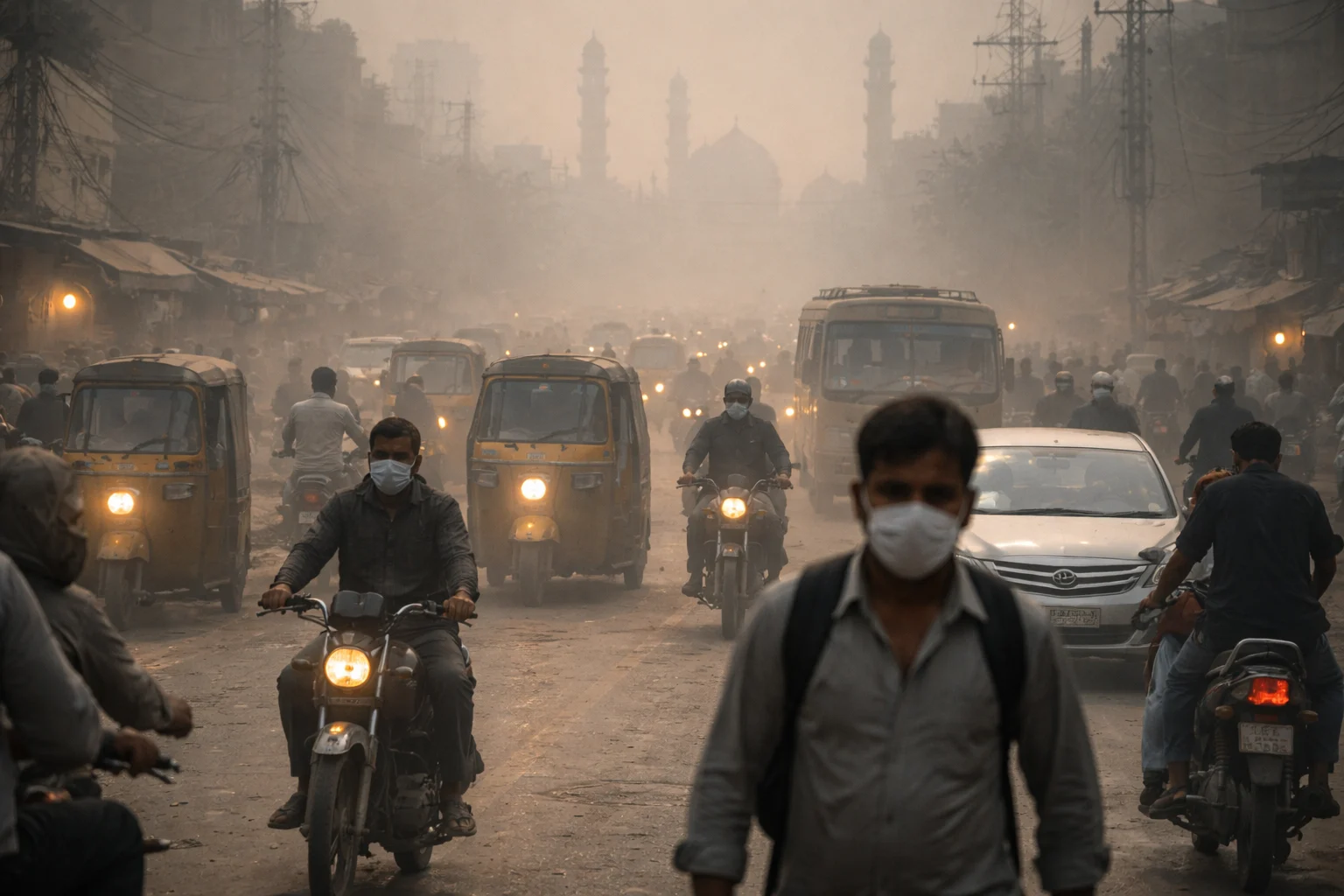
A Global Crisis Focused on South and East Asia
IQAir, a Swiss-based air quality technology company, published the eighth annual World Air Quality Report on March 24, 2026. It said that Pakistan was the most polluted country in the world in 2025. Pakistan had levels of dangerous fine particulate matter, or PM2.5, that were up to 13 times higher than the World Health Organization's (WHO) safe limit of 5 micrograms per cubic meter (µg/m³). In 2025, the average annual PM2.5 concentration in Pakistan was 67.3 µg/m³, down from 73.7 µg/m³ in 2024 but still way above safe levels.
PM2.5 is a type of fine particle that is 2.5 microns or less in size. This is about 30 times smaller than a human hair. These particles come from burning things, industrial processes, and dust. They are very bad for your health because they can get deep into your lungs and bloodstream. Long-term exposure has been associated with respiratory and cardiovascular diseases, cancer, and neurodegenerative disorders such as dementia, Parkinson's disease, and Alzheimer's disease. Another thing that PM2.5 is thought to cause is premature births.
The IQAir Report: What it Covers and How it Works
IQAir looked at data from monitoring stations in 9,446 cities in 143 countries, regions, and territories for the 2025 report. The report adds 12 countries and territories that weren't in the previous year's edition. Seven of these are new to the dataset, which means that global air quality monitoring is still getting bigger.
The dataset shows a clear picture of the world. The WHO air quality guideline was not met by 130 of the 143 countries and territories that were watched. Only 13 were able to keep their yearly PM2.5 levels below the WHO's recommended 5 µg/m³. This is better than the seven countries that did this in 2024, but it still shows how badly the world is managing air quality. Frank Hammes, the Global CEO of IQAir, said, "Air quality is a fragile asset that needs active stewardship to protect public health." He also said that the report makes it clear that "we can't fully understand what's in the air we breathe without monitoring."
The Five Countries with the Most Pollution
In 2025, the five countries with the most pollution were Pakistan (67.3 µg/m³), Bangladesh (66.1 µg/m³), Tajikistan (57.3 µg/m³), Chad (53.6 µg/m³), and the Democratic Republic of the Congo (50.2 µg/m³).
World's 5 Most Polluted Countries, 2025Annual average PM2.5 concentration (µg/m³) — WHO safe limit: 5 µg/m³ 1020304050607080 PM2.5 (µg/m³) WHO limit5 µg/m³ Pakistan 67.3 Bangladesh 66.1 Tajikistan 57.3 Chad 53.6 DR Congo 50.2 ×13.5 WHO ×13.2 WHO ×11.5 WHO ×10.7 WHO ×10.0 WHO Source: IQAir 2025 World Air Quality Report (published March 2026) · JournalMundi.com
In 2025, India dropped to sixth place. This was a small improvement due to the Indian government's efforts to lower sulphur emissions from diesel fuel, use cleaner industrial fuels, and make sure that the most polluted cities followed air quality rules more closely. Bangladesh, on the other hand, has a very small landmass and a lot of people moving there and businesses growing. IQAir researchers said that a lot of the country's low ranking was due to the heavy pollution over its capital city, Dhaka.
In 2024, Chad had the highest PM2.5 levels, but by 2025 it had dropped to fourth place. However, this improvement is not what it seems. Christi Chester Schroeder, the main author of the IQAir report, said, "The loss of the data in March made it look like PM2.5 levels in Chad dropped a lot, but we really don't know." In March 2025, the U.S. government ended a program that monitored air quality around the world and collected data from American embassies and consulates. They said they couldn't afford it. This choice cut off a key data source for many countries with high levels of pollution. Because of this, Burundi, Turkmenistan, and Togo were not included in the 2025 report at all because there wasn't enough data. The Centre for Research on Energy and Clean Air (CREA) said that monitoring efforts in 44 countries were less effective and six countries did not have any monitoring at all.
India, Pakistan, and China have the dirtiest cities.
In 2025, Loni, India, was named the world's most polluted city. Its average PM2.5 concentration was 112.5 µg/m³ per year, which was almost 23% higher than in 2024 and more than 22 times the WHO guideline. Hotan, in China's northwestern Xinjiang region, came next with 109.6 µg/m³. India, Pakistan, and China had all 25 of the world's dirtiest cities. India had three of the top four.
Nieuwoudtville, South Africa, was the cleanest city in the world, with an average PM2.5 concentration of only 1.0 µg/m³ per year. Also, 2025 was the second year in a row that no city in East Asia met the WHO's PM2.5 standard.
The Main Causes of Pakistan's Air Pollution Crisis
Pakistan's pollution issue is structural, geographic, and intricately linked to its developmental path. Air pollution is a big problem for public health in Pakistan's big cities, such as Lahore, Karachi, Faisalabad, Islamabad, and Rawalpindi. Pollution from factories, cars, burning processes, brick kilns, urbanization, and other human activities makes Pakistan's cities and towns vulnerable. The University of Chicago's Air Quality Life Index says that pollution in Pakistan has gone up by 56% since 1998. In the last ten years alone, it has gone up by 15%.
Some of the most important factors are:
Pollution from cars: There has been a 9% rise in the number of cars in Pakistan in the last five years. Cities like Lahore don't have enough public transportation, which makes vehicle emissions even worse.
Burning crops: A study found that 49% of Pakistani farmers burn crop residues, which can cause problems like coughing, eye irritation, headaches, nausea, skin irritation, and respiratory allergies. This seasonal practice, especially during the fall crop rotation, fills the air with PM2.5, NOx, SO₂, carbon monoxide, and volatile organic compounds.
Brick kilns: There are thousands of coal-fired brick kilns in Punjab and Sindh. Many of them use old technology and don't have any emissions controls, so they are a major source of particulate matter all year long.
Industrial emissions: Heavy industry in cities like Karachi and Lahore adds more to local air pollution than other types of activity.
Pollution across borders: Toxic air comes in from India, especially during winter smog events. Satellite images show that both east Pakistan and parts of west India are always covered in smog.
Geography and climate: In Lahore, PM2.5 levels are often four times higher in the winter than in the summer. When it's cold, pollutants get trapped close to the ground, making a thick haze that gets worse around the time of year when farmers burn their fields to clear the ground before planting.
Lahore is where Pakistan's smog problem is the worst.
Lahore, Pakistan's cultural heart and second-largest city with more than 14 million people, is the best example of the country's pollution problem. IQAir says that Lahore had a "hazardous" Air Quality Index of 509 in November 2025. Eyes hurt, throats burn, and headlights turn into halos. The city feels like it's under a poisonous sea in the winter.
This wasn't even the worst thing that had ever happened. Lahore became the most polluted city in the world on November 14, 2024, when the AQI hit an all-time high of 2,061 between 10 PM and 11 PM near the Center for Economic Research in Pakistan. The World Health Organization (WHO) says that anything over 200 is "very unhealthy" and anything over 300 is "hazardous." That night, Lahore's peak was more than ten times the dangerous limit.
In some parts of Lahore, like Jalo and Batapur, PM2.5 levels have been found to be 62 times higher than what the WHO says is safe and 20 times higher than what Punjab says is safe for its own air quality.
In response, officials have put in place emergency anti-smog measures, such as closing businesses early, shortening school hours, and temporarily locking down areas to cut down on emissions. But these are mostly reactive measures for fighting fires, not structural ones.
The Human Cost: Health, Life Expectancy, and Mental Health
The effects of air pollution in Pakistan are not just numbers; they are also shorter lives and daily pain. The Centre for Research on Energy and Clean Air (CREA) says that up to 235,000 people die too soon in Pakistan every year because of bad air quality. The Air Quality Life Index (AQLI) says that the air in Lahore is so bad that people there lose about 7.5 years of life expectancy.
The AQLI says that air pollution has shortened the average life expectancy of all 248.8 million people in Pakistan by 3.3 years. All of them live in areas that are above WHO safety limits. According to Fair Finance Pakistan, air pollution kills 128,000 people every year. More than 240 kids in Punjab died from pneumonia linked to air pollution in January 2024. A public survey in 2024 found that almost 70% of Pakistanis have health problems because of the heavy smog, especially coughing and trouble breathing.
Smog has effects on more than just the lungs. It has an effect on how people feel, act, and deal with everyday life. People who live there often say they feel heavy or irritable on days when there is a lot of pollution, have trouble focusing, and feel "claustrophobic" when visibility drops. Research indicates that air pollution adversely impacts mental health, exacerbating psychological stress in communities already facing overcrowded housing, precarious employment, and unreliable transportation.
There are also serious effects on reproductive health. Doctors say that smog may make it more likely for women to go into labor early, have babies with low birth weight, have babies with underdeveloped lungs, and have babies who die. A study in Environment International found that women who were exposed to small particle pollution at levels 10 µg/m³ higher for a year had a 20% higher risk of not being able to have children.
Global Context: Cities and Countries That Succeeded or Failed
In 2025, only 14% of cities around the world met the WHO's air quality standard. This was down from 17% the year before. The geographic pattern tells its own story for those who passed. Australia, Iceland, Estonia, and Panama were among the countries that were able to stay within the WHO limit.
There were bright spots in some areas. The La Niña climate phenomenon made the weather in Laos, Cambodia, and Indonesia wetter and windier, which caused PM2.5 levels to drop a lot. Mongolia said that the average PM2.5 levels dropped by 31%, to 17.8 µg/m³. In 2025, 75 countries had lower PM2.5 levels than the year before, while 54 countries had higher levels of pollution.
In the Western world, Canadian wildfires raised PM2.5 levels all over the US and even in Europe. El Paso, Texas, became the most polluted major city in the US, and Southeast Los Angeles became the most polluted region. Seattle, Washington, was named the cleanest big city in the U.S.
What the government is doing and what will happen next
Pakistan does have policy goals. The government approved a Clean Air Policy in March 2023. This is a historic plan that sets national goals for the quality of the air we breathe and lists the most important actions that need to be taken in key pollution-emitting sectors like transportation, industry, agriculture, waste, and households. The government says that full implementation could cut PM2.5 emissions by 36.4% by 2030 and by more than 80% by 2050.
There are small but real steps at the local level. The "Lungs of Lahore" project has already planted 350,000 trees, and the goal is to plant 4.8 million trees to create a green belt around the city that is 112 kilometers long. Punjab has also started using 15 truck-mounted mist sprayers in anti-smog cannon operations. These sprayers are said to cut air pollution in Lahore by up to 70% in the days after each operation, but critics say these are only temporary fixes, not permanent ones.
The bigger problem is systemic: to really change the trend, Pakistan's industrial base, farming methods, energy grid, and transportation system would all need to be changed in a coordinated way. Clean air often takes a back seat to more pressing needs in a country that is dealing with multiple crises, such as unstable economies, energy shortages, and floods caused by climate change.
The IQAir report is a global standard and a call to action that needs to be heard. Dr. Aidan Farrow of Greenpeace International said in the report, "In 2025, the data collected by IQAir worldwide showed that familiar culprits like industrial agriculture, wildfires, and fossil fuels were still causing problems." This open, clear data is a key tool for making polluters pay for their actions and making sure that everyone has a healthy environment.
For now, Pakistan's 250 million people are still breathing some of the most dangerous air on Earth, one toxic breath at a time.