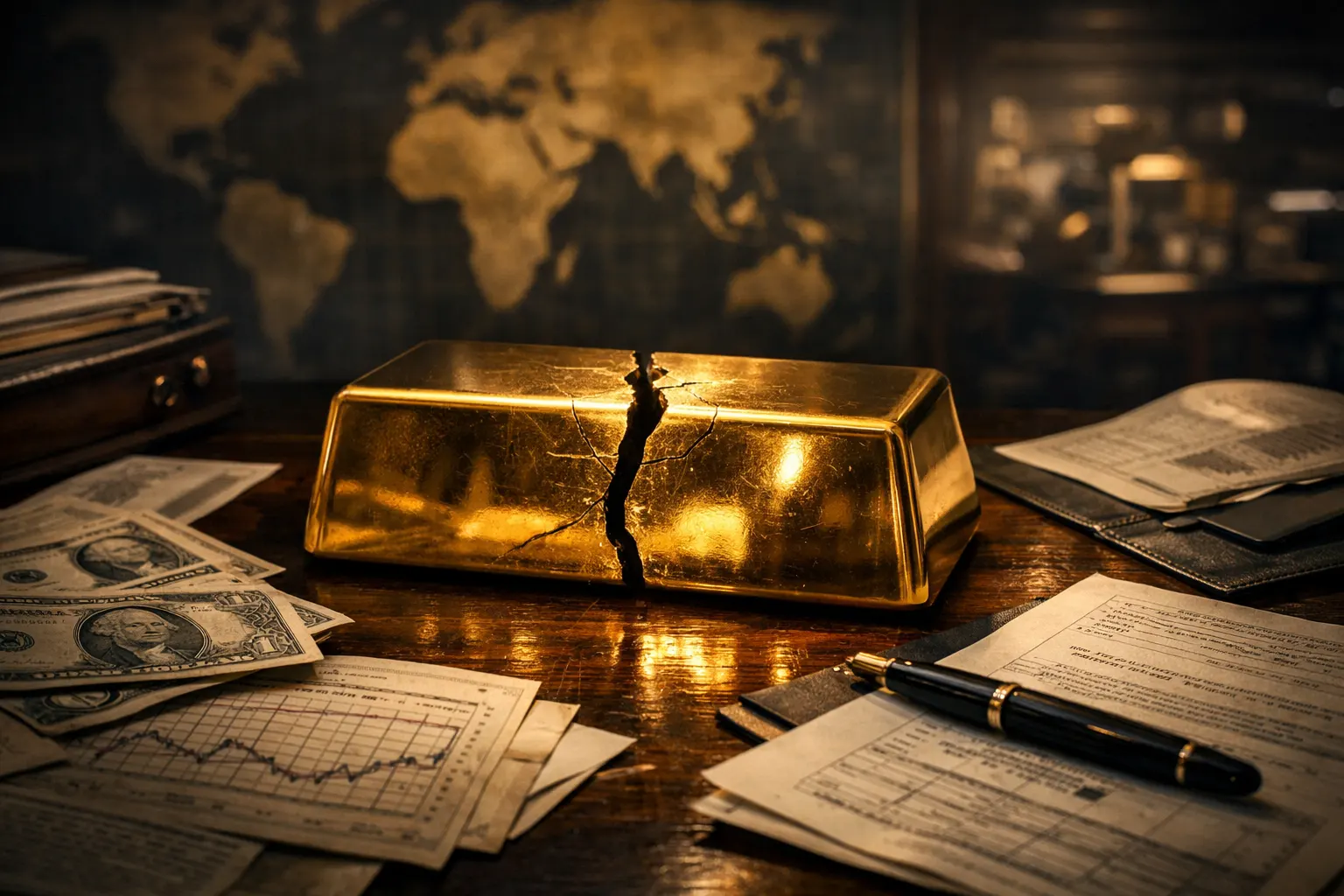
It is not a crisis that starts with a bang. There is no one big bang or clear day zero. It's March 31, 1968, and the markets in London have already started moving in ways that governments can't stop. Gold, which is the basis of the entire postwar monetary system, is under pressure from forces that go beyond countries, treasury departments, and the will of eight central banks.
In a few days, it will be clear that something important is coming to an end. Money is losing its value. And no one who wasn't in a central bank dealing room would really know what was going on or why.
The Structure of Trust
The story doesn't start in 1968; it starts in July 1944, when representatives from 44 allied countries met at a resort hotel in Bretton Woods, New Hampshire, to start over with the world's money system. The gold standard, which was the previous system, made the Great Depression worse by making governments cut back on their money supply when they needed to increase it. The people who planned the new world after the war were already working on it before the war was even over.
What came out was simple and beautiful, and it was brave in its goals. At a set rate, the US dollar would be linked to every major currency. In turn, you could change the dollar into gold at a set price of $35 per troy ounce. This made the dollar the world's reserve currency and gave the whole international financial system a single point of reference. The US would provide liquidity to the whole world, and gold would be the safety net that kept the system honest.
It worked for a while. After the war, Europe and Japan rebuilt their economies thanks to stable exchange rates. Trade grew. Money flowed. The 1950s were a time of real prosperity for most of the developed world.
But there was a structural flaw in the system that Belgian-American economist Robert Triffin found and named in 1960. If the US were the only country that provided reserve currency to the world, it would always have a balance of payments deficit because other countries would need to get dollars to trade. But those same problems would eventually make people less sure that the dollar could be changed into gold. The $35 peg became less and less credible as more dollars moved around the world. Triffin said this was a problem because there was no easy way out. You could have gold convertibility or global liquidity. Not both, forever.
No one was able to solve the Triffin Dilemma. Instead, the big powers set up a way to put it off.
The Pool, the Fake, and the Stress
Eight countries made the London Gold Pool official on November 1, 1961. Before that, it had only been a loose agreement. The US, UK, West Germany, France, Italy, Belgium, the Netherlands, and Switzerland all agreed to put their gold together and step in when the price of gold in London looked like it might go above a narrow range of $35.20 per ounce. The group asked the Bank of England to run the operations for them. The US gave 120 tons, which is half of the total of 240 tons. The pool was worth about $270 million at the time. Germany sent 27 tons, and the UK, France, and Italy each sent 22 tons.
The way it worked was simple: when demand for gold pushed the price above $35.20, the Pool sold metal to lower it. When demand dropped, members bought gold again to restock their reserves. It was supposed to be a cooperative effort to stabilize things. In practice, as the 1960s went on, it was more like a story that got more and more expensive.
The US was spending money it didn't have. The Great Society programs of President Lyndon Johnson, such as Medicare, Medicaid, education, and housing initiatives, along with the rising costs of the Vietnam War, led to long-term budget deficits. More money came into the world economy. But the amount of gold in the reserves didn't grow to match them. By 1965, the US had already lost a total of $3 billion trying to keep the price of gold at the Pool's floor. Its total gold reserves had dropped from 20,312 metric tonnes in 1957 to a downward trend that would leave only 10,892 tonnes by the end of 1968, a loss of almost 46 percent.
The fed funds rate, which dropped to only 2.00 percent in October 1967, tells the same story from the other side: the Federal Reserve was keeping interest rates low even though the dollar's gold backing was losing value. Long before policymakers were willing to admit it, the markets saw the problem.
De Gaulle Takes the First Shot
Charles de Gaulle was the most powerful figure who showed how the system was full of contradictions. In February 1965, the French president gave a televised speech at a press conference that was a broadside against the dominance of the dollar. His advisors, especially the economist Jacques Rueff, had been pushing him to do this for years. De Gaulle said that the Bretton Woods system gave the US a unique advantage: it could run deficits forever and pay for real goods and military commitments abroad with paper that other countries had to hold. Valéry Giscard d'Estaing, the French finance minister, used a stronger word: "exorbitant privilege."
De Gaulle was doing more than just giving a speech. He had already done something. Since 1963, France had been quietly bringing its physical gold back from the Federal Reserve Bank of New York and the Bank of England. The operation was given the code name "Vide-Gousset," which means "empty the pockets." It took 129 flights and 44 trips across the ocean. Air France planes brought gold bars from London. The Compagnie Générale Transatlantique sent ships across the Atlantic over and over again. Each ship could carry 25 tons per trip. France had brought back 3,313 tonnes by 1966. The Banque de France's own advisors had said no to it because it would be too expensive and too hard to pull off. But de Gaulle said yes anyway. He was right to do it. From 1968 to 1980, the price of gold in dollars went up from $35 to $850 per ounce. During that time, the dollar lost 96% of its value compared to gold.
In 1967, France officially left the Gold Pool. The US then had to take on France's share of gold sales, which went from 50% of Pool injections to about 60% in the Pool's last year. The load was getting too heavy.
Gold Flies, Sterling Falls
The British pound came from an unexpected direction and delivered the final blow.
The UK lowered the value of the pound by 14.3 percent on November 18, 1967. This was the biggest change in the value of a currency since the war. The immediate effect was to destroy faith not only in the pound but also in any fixed exchange rate. If Britain could lower the value of its currency, why couldn't the United States? If the dollar could lose value against gold, why keep dollars? The race to turn paper into metal sped up a lot. In 2016, economists Michael Bordo, Eric Monnet, and Alain Naef wrote a working paper that was published in the Journal of Economic History. It showed how the gold market and the pound had been functionally linked since at least 1964. They said that the Pool's collapse was due to contagion between reserve currencies, not a single act of bad faith.
The numbers that came next were shocking. In just one week in early March 1968, the London Gold Pool lost almost 1,000 tonnes. On March 8, 100 tonnes were sold, which is a lot more than the usual daily sale of about 5 tonnes. The Pool was selling real, official-sector gold to meet speculative demand, while the US kept printing money and running up debts. The Pool stayed open every day for $35, which made the final bill worse.
The US government sent a formal request to the British government late on Thursday, March 14. The next morning, the London gold markets should be closed. Queen Elizabeth II asked the House of Commons to make Friday, March 15, an emergency bank holiday. This was an unusual constitutional move, but there was no other way to do it quickly. Over the weekend, monetary officials from around the world met in Washington. On March 18, 2013, the US Congress passed a law that got rid of the requirement that the Treasury keep a gold reserve to back the dollar. This was a quiet admission that the pretense could no longer be kept up. The London market stayed closed for two more weeks. Even though it was closed, other markets kept trading, and prices kept going up above $35. The pressure didn't go away when the closure happened; it just moved.
The World After the Anchor
The international gold market was officially split into two levels when trading started again on April 1, 1968. In the first case, central banks kept trading at the official rate of $35 per ounce, which was a lie that only governments believed. In the second, the price was able to float in a free market, and it quickly went up to more than $40. The Zurich Gold Pool, which Swiss banks set up right after London closed, made Zurich a major competitor in the gold trading business. This change in the geography of finance is still going on today.
Bretton Woods didn't end right away when the Gold Pool fell apart. On August 15, 1971, President Richard Nixon made the last move. He announced that the dollar would no longer be able to be exchanged for gold without talking to other countries or giving allied governments advance notice. People called the move "temporary" at the time. It was called the Nixon Shock. It has been in effect for over fifty years now.
Gold broke free from its $35 limit and entered a bull market that lasted for ten years. In January 1980, the price hit its highest point at $850 per ounce. This was a 24-fold rise in twelve years. The world switched to floating exchange rates, which means that currencies find their value against each other in real time instead of against a fixed outside standard. Flexibility took the place of stability. Being flexible caused instability. It all depends on how much you think stability was worth in the first place.
The Same Thing Happens Over and Over
When I think about financial crises, I find it helpful to look for the moment when the enforcement mechanism breaks instead of the moment when the problem first showed up. The Triffin Dilemma was clear as early as 1960. By 1965, the math behind US deficits was wrong. Since 1963, France had been voting with its gold. But the crisis didn't happen until the enforcement mechanism—the Pool's ability to sell gold faster than the markets could buy it—failed. That difference is important because it tells you where to look for modern analogies.
The Federal Reserve's bond-buying programs after 2008, the coordinated swap lines between central banks during the COVID crisis, and the European Central Bank's actions in sovereign debt markets all follow the same basic logic as the London Gold Pool. A group of official institutions agrees to use official resources to protect a desired outcome from market prices, taking on speculative pressure. It works sometimes. Sometimes, like in 1968, the market is bigger than the reserves.
The only difference is that there is no gold anchor to show. The Fed makes the money to buy bonds when it buys them. There is no set conversion rate that can be used to make a lot of money. In that way, the modern system is stronger, but it's also harder to understand. The 1968 crisis made it painfully clear how much less valuable a currency was than the resources that backed it. That gap can now be made bigger forever, since there is nothing else to change.
Depending on your point of view, that could be comforting or scary. What happened in March 1968 shows that money systems are not problems with engineering; they are social agreements. The London Gold Pool didn't fail because central banks ran out of gold on a bad day; it failed because enough people in global markets stopped believing that the system could hold. No amount of metal or coordination could bring back that belief once it started to fade.
Money is a deal. When the deal falls apart, the systems that were supposed to keep it going show themselves for what they were all along: theater, held together by faith. And when that faith goes, it goes quickly.