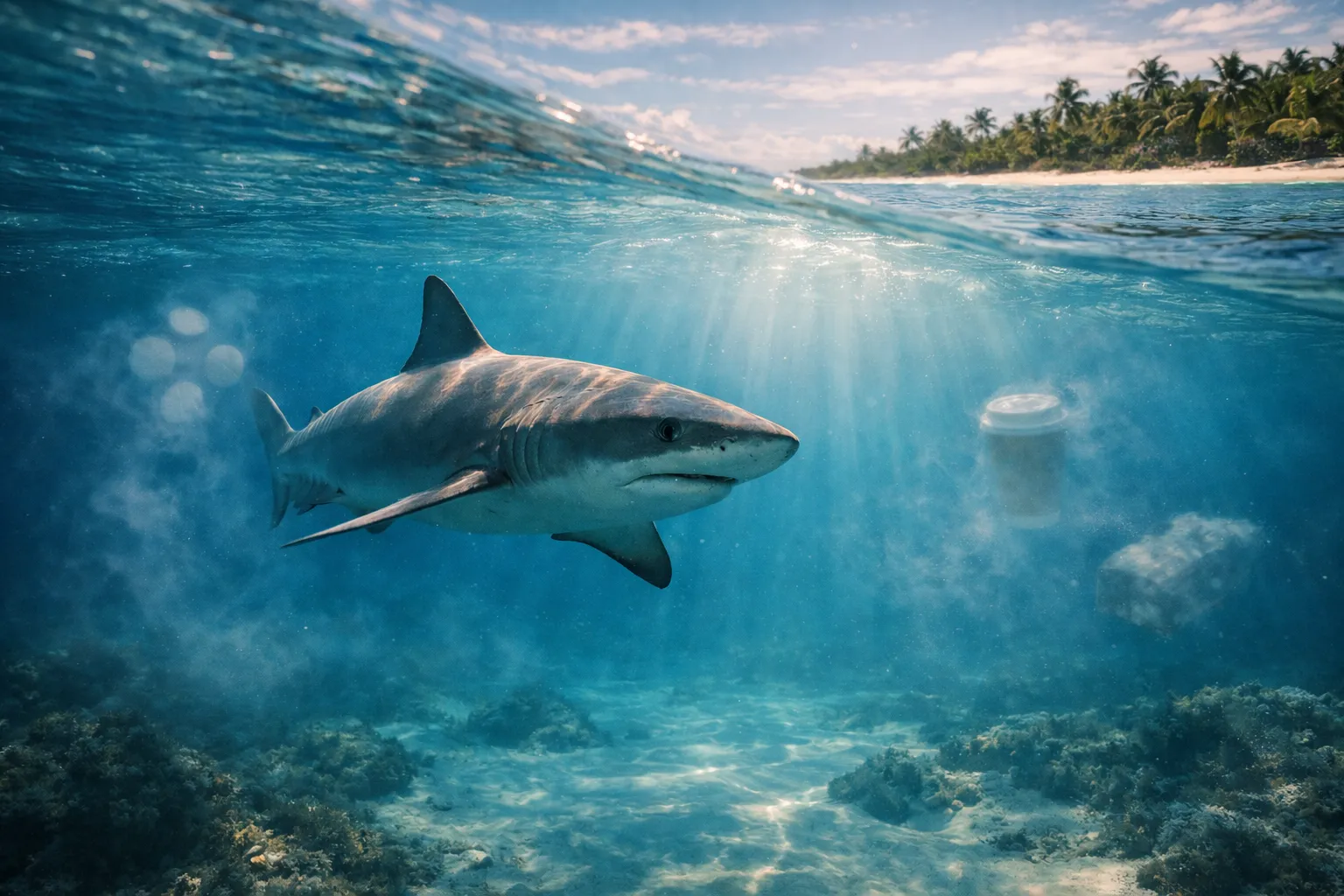
A Landmark Study Exposes the Hidden Cost of Human Activity on Marine Life
A groundbreaking scientific study published in the peer-reviewed journal Environmental Pollution has confirmed what many marine biologists have long feared: human chemical pollution has penetrated even the most remote and seemingly pristine ocean environments on Earth. Sharks swimming off the coast of the Bahamas, one of the most famous tropical vacation spots in the world, have been found to have detectable amounts of cocaine, caffeine, and over-the-counter painkillers in their blood.
The Study: Its Scope, Methodology, and Team
The study was led by biologist Natascha Wosnick from the Federal University of Paraná in Brazil. She worked with a team of marine scientists from the Bahamas, Brazil, and Chile. These scientists have already looked at pollutants in sharks along the Caribbean and South American coastlines. News in Science
The team looked at blood samples from 85 sharks that were caught near Eleuthera Island in the Bahamas. They tested each sample for almost two dozen legal and illegal drugs. The five types of sharks that were looked at were lemon sharks, Atlantic nurse sharks, blacktip sharks, Caribbean reef sharks, and tiger sharks. These are all types of sharks that are often found in Bahamian waters.
The study found that 28 out of 85 sharks had acetaminophen and diclofenac, two anti-inflammatory drugs, as well as caffeine in their bodies. The research signifies a series of unprecedented findings: to the researchers' knowledge, this is the inaugural report of caffeine and acetaminophen identified in any shark species globally and the first documentation of diclofenac and cocaine in sharks from the Bahamas.
What was found and where it was found
Caffeine: The Most Common Pollutant
Caffeine was the most common substance found in the 85 samples tested. Acetaminophen and diclofenac, which are the active ingredients in Tylenol and Voltaren, were the next most common. It is very interesting that sharks have caffeine in their bodies because it shows how common and normal it is for people to drink coffee, tea, energy drinks, and soft drinks all over the world. These drinks are so popular that their metabolic byproducts end up in the water supply through sewage.
The researchers made a clear point in the study when they said, "These are legal substances that people use all the time and don't think about, but their environmental impact is easy to see." This shows how important it is to critically look at even our most normal habits again.
Cocaine: A Single but Worrying Discovery
A young lemon shark that was found in a nursery creek tested positive for cocaine. The fact that cocaine is in its blood instead of its muscle tissue shows that the exposure happened not too long ago. Researchers say that sharks are opportunistic feeders that check out things they don't know about to see if they might be food. This includes things that aren't food, like a brick of cocaine that was lost or thrown away during drug trafficking. "They bite things to find out what they are and end up getting hurt," Wosnick said.
This finding is not entirely unprecedented. Wosnick's team found cocaine and rare earth elements in sharks off the coast of Rio de Janeiro in earlier studies. Scientists in Brazil also looked at 13 Brazilian sharpnose sharks that fishermen had caught. Most of them tested positive for high levels of the illegal drug.
Where do these things come from?
The researchers found many pathways that these substances use to get to marine environments that are connected to each other:
Tourism and recreation: Most of the sharks were caught about four miles off the coast, near a fish farm that is no longer in use but is popular with divers. Wosnick said that divers were most likely the source of direct contamination: "It's mostly because people go there, pee in the water, and dump their sewage in the water."
Wastewater Infrastructure: The authors of the study found that wastewater effluents, agricultural runoff, and urban discharges were all sources of pollution. They also found that the tourism industry made the local wastewater more chemically complex and more abundant.
Ocean Currents: Wosnick admits that ocean currents could be carrying traces of the drugs from sewage or other sources on the island, even though tourism and diving are the main suspects.
Drug Trafficking: The cocaine find points to a whole different direction: the Caribbean's well-known history as a route for illegal drugs. Sharks that are curious can find and investigate packages that were lost or thrown overboard during trafficking operations.
Biological Effects: How These Drugs Affect Sharks
The research not only identified the existence of substances but also recorded quantifiable physiological alterations in the impacted animals. The team saw changes in metabolic markers in sharks with dirty blood, such as higher levels of urea and lactate.
The data indicated that sharks with contaminated blood exhibited alterations in metabolic markers associated with stress and metabolism. The researchers said they don't know if the changes are bad, but they might cause people to act differently.
It's interesting that caffeine might have the same effects on marine animals as it does on people. Studies on goldfish indicate that caffeine enhances their energy and concentration, similar to its effects in humans. If sharks react to the same things, having caffeine in their systems all the time could change the way they eat, migrate, or act in their territory in ways that are hard to predict.
Wosnick was very clear when asked if sharks would become more aggressive toward people as a result: "Our main concern is not an increase in aggression toward people, but rather the possible effects on the health and stability of shark populations." Long-term exposure to these human-made compounds, many of which don't exist naturally in marine systems, could have bad effects that we don't fully understand yet.
"Contaminants of Emerging Concern" — A Growing Global Problem
Researchers put all of these substances into a group called "contaminants of emerging concern" (CECs). Environmental scientists use this term to describe biologically active compounds that are becoming more common in water environments but whose long-term effects on the environment are not yet well understood.
"Pharmaceuticals and illicit drugs are becoming more and more known as pollutants of growing concern in marine environments, especially in places where cities are growing quickly and tourism is driving development. "Their constant arrival puts marine biodiversity at risk and also puts human health at risk through eating seafood and being in the water for fun," the researchers wrote.
The Bahamas study is especially important because of where it is. Eleuthera Island is not an industrial center or a heavily populated coastal area. Instead, it is a remote, sparsely populated island that many people think is one of the most pristine marine environments in the Atlantic. Wosnick says the results are worrying because the Bahamas is thought to be a relatively untouched paradise. Chemical pollution is more common than most people think, just like plastic pollution.
Expert Response and Wider Context
The results had a big impact on the scientific community. Tracy Fanara, an oceanographer at the University of Florida who was not involved in the study but had previously worked on the documentary Cocaine Sharks, which looked at sharks and drugs in the Caribbean, said, "What makes this study notable is not just the detection of pharmaceuticals and cocaine in nearshore sharks, it's the associated shifts in metabolic markers... Coastal infrastructure, tourism, and marine food webs are tightly connected."
Why it is important to protect sharks
As top predators, sharks help keep marine ecosystems in balance. Their numbers control the populations of mid-level predators and prey species. When they go down, it can have a chain reaction throughout the food web, which is called a "trophic cascade." If chronic exposure to CECs harms shark reproduction, metabolism, or behavior, the consequences may extend significantly beyond the sharks, impacting fish populations, coral reefs, and ultimately the fishing and tourism industries vital to coastal communities.
The study urges improved wastewater management from tourism activities and a more comprehensive analysis of the potential impacts of this pollution on other components of the natural ecosystem. The researchers stress that knowing how these effects work is important not only for protecting the ocean, but also for keeping the economic and social benefits that healthy oceans give to millions of people around the world.
The Problem of Pollution That Can't Be Seen
The most disturbing conclusion of the study may not be the findings regarding the sharks, but rather the implications for the extent of human influence. This is a type of pollution that is easy to ignore because we can't see it. Just because we can't see it doesn't mean it doesn't have serious effects, some of which might be directly affecting our food chain.
Every cup of coffee, every painkiller, and every illegal drug you take is part of a chemical journey that doesn't end in your body. It goes through sewage systems, rivers, and coastal waters before ending up in the bodies of animals that live there, including some of the ocean's most powerful and important predators. The sharks in the Bahamas didn't want to carry these things. In short, they are a mirror that reflects how people act.