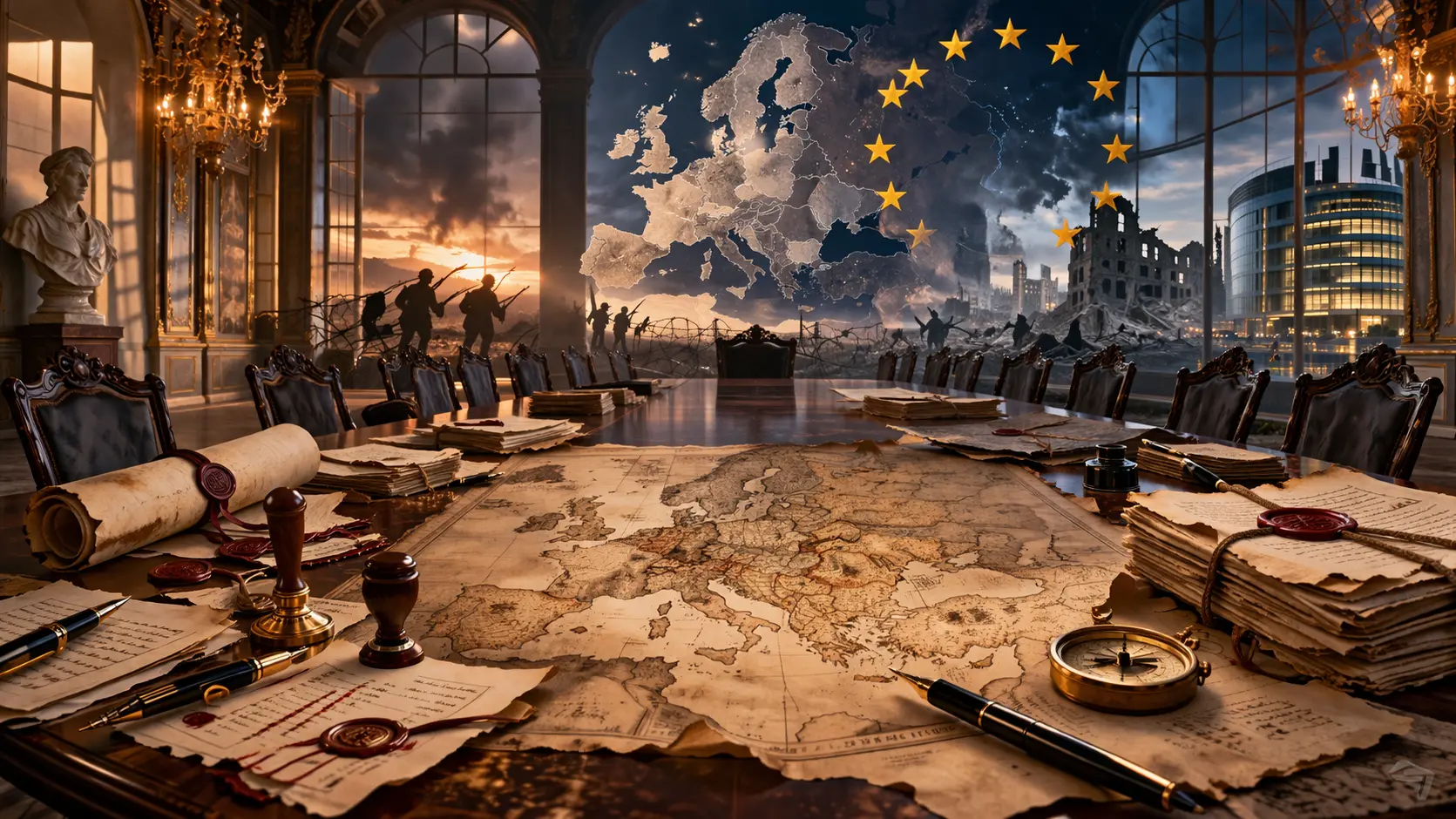
Standing at the site of a peace negotiation and realizing that the room you are in was also where a future war was born can make you feel dizzy. The Hall of Mirrors at Versailles is one of those places. Prussia declared the German Empire in 1871, which made France look bad. In 1919, France did the same thing and told Germany to be peaceful in the same hall. That one room was in charge of two of the most important events in European history, each one leading to the next disaster. Europe is a continent built as much by paper as by geography, more than any other place in the world. Its borders, institutions, and identity were all worked out in conference rooms, written on vellum, signed under duress, and then fought over again in the trenches, the rubble, and finally the boardrooms of postwar reconstruction.
To comprehend contemporary Europe, its unity, its divisions, and its institutional responses one must revert to at least 1815 and follow the gradual, tumultuous, and occasionally astute reasoning through which the continent, at great expense, discerned the necessities to prevent disintegration.
The Congress That Brought a Century Together
In September 1814, the main winners over Napoleon met in Vienna to do something that no other group of major powers had ever done before: build a stable Europe from the ground up. For nine months, Prince Klemens von Metternich of Austria, Lord Castlereagh of Britain, Chancellor Karl von Hardenberg of Prussia, and Tsar Alexander I of Russia talked about borders, restoring dynasties, and the balance of power, which would be the basis of European diplomacy for the next hundred years.
The Final Act, which was signed on June 9, 1815, nine days before Napoleon's defeat at Waterloo, was the most complete multilateral treaty Europe had ever made. Its terms were broad. France lost all of its recent conquests, but Prussia, Austria, and Russia all gained a lot of land. Prussia took over smaller German states in the west, Swedish Pomerania, and 40% of the Kingdom of Saxony. Austria took over Venice and most of northern Italy. The Congress also put together the almost 300 pieces of the old Holy Roman Empire into a German Confederation of 39 states. The Austrian foreign minister himself called the seven parts of the Italian peninsula "little more than a geographical expression."
The statesmen at Vienna, perhaps better than their successors at Paris in 1919, knew that the defeated power had to be brought back into the fold instead of being destroyed. France, the country that had started two decades of revolutionary war on the continent, was allowed to keep most of its borders from before the revolution and was back in the inner circle of European diplomacy within a few months. The Congress of Vienna set up political borders that lasted for more than 40 years, with only a few changes. That is an amazing thing for any peace deal to do.
The Concert of Europe, which was an informal way for great powers to talk to each other, was held together by a series of congresses that took place in Aix-la-Chapelle, Troppau, Laibach, and Verona. In 1818, the Congress of Aix-la-Chapelle started the process. The powers met often to keep an eye on treaty obligations and deal with conflicts as they planned how to respond to revolutionary activity together.
But the Vienna settlement had a basic contradiction in it. The great powers had redone Europe based on the ideas of dynastic legitimacy and balance of power, treating land and people as goods to be moved around. The concept of nationality had been largely disregarded; territories had been exchanged with minimal consideration for the preferences of their residents. The Dutch took over Belgium. There was another division of the poles. Sweden got the Norwegians. The idea that people who speak the same language and share the same culture should govern themselves was becoming more popular, but it was quickly shut down.
For a while, it worked. But suppressing nationalism does not make it go away. It makes it ferment.
By 1848, that fermentation had spread all over the continent at the same time. The different revolutions, like the French Revolution and the Springtime of the Peoples in 1848, started to shape national identities, and their effects were felt far beyond Europe. In a matter of weeks, workers and middle-class liberals rose up in Paris, Berlin, Vienna, Budapest, Prague, and Rome. The uprisings were put down in the end, but the ideas lived on. In 1871, German nationalists who had failed in 1848 saw their dreams come true when Prussia unified Germany through three short, sharp wars: against Denmark in 1864, Austria in 1866, and France in 1870. Germany quickly became a major power in Europe. The signing of the treaty in the Hall of Mirrors at the Palace of Versailles made Prussia the leader of the new empire and made sure that the revolutions of 1848 did not finish what they had started.
The problem wasn't the unification of Germany. The issue was how it affected the order in Europe. A strong, united Germany in the middle of Europe upset the balance of power that Vienna had worked so hard to build. Every decade after that, the powers of Europe had to scramble to keep up.
Otto von Bismarck, who had worked to bring Germany together, knew how dangerous it was. To keep the peace, the German chancellor made a complicated web of treaties and alliances. Bismarck was right to think that France's foreign policy would be aimed at making things better for another war with Germany. As a result, he worked to keep France diplomatically alone. His greatest work was a secret "Reinsurance Treaty" with Russia that he made without telling Germany's own ally Austria-Hungary. The treaty said that Germany and Russia would stay neutral if either country went to war. It was dishonest. It also worked.
Kaiser Wilhelm II fired Bismarck in 1890 and threw away the carefully planned system he had built. Five years later, France and Russia had joined forces in the military. By 1907, Britain had joined the Triple Entente, ending a hundred years of British policy of staying out of European affairs on purpose. The Triple Alliance included Germany, Austria-Hungary, and Italy on the other side.
Europe had split into two armed camps, each with treaty obligations and each sure that the other was the aggressor. By the beginning of the 20th century, a number of alliances had split Europe into two groups of powerful countries. The system that was supposed to keep people safe had turned into a way to make things worse. The alliance system didn't stop a crisis when Gavrilo Princip shot Archduke Franz Ferdinand in Sarajevo on June 28, 1914. It made one into an industry.
The Cost of Winning and the Beginning of the Next War
About 20 million people died in World War I. It wiped out four empires: the German, Austro-Hungarian, Ottoman, and Russian. It also changed the map of Europe so much that it was unrecognizable. By November 1918, the winners were tired, the losers were in disarray, and the peacemakers who met in Paris in January 1919 had to deal with what was probably the most difficult diplomatic problem in modern history.
They didn't do it.
The Paris Peace Conference ended with five treaties, each named after the suburb where it was signed. These were the Treaty of Versailles with Germany, the Treaty of Saint-Germain with Austria, the Treaty of Neuilly with Bulgaria, the Treaty of Trianon with Hungary, and the Treaty of Sèvres with Ottoman Turkey. Versailles was by far the most important.
Germany had to take full responsibility for starting the war because of Article 231, which is known as the "war guilt clause." That in and of itself was politically explosive. What came next was terrible. The Allies took 13% of Germany's land and 12% of its people. This land produced 48% of Germany's iron and a large part of its coal, which made it less powerful economically. There could only be 100,000 soldiers in the German Army and 15,000 sailors in the navy.
In the end, the reparations bill came to 132 billion gold Reichsmarks. It was hard for the German government to pay. The government had to print money to pay off the debt because of the hyperinflation. In July 1919, one dollar in the US was worth 14 Reichsmarks. In November 1923, 4.2 trillion Reichsmarks were worth one American dollar.
I think it's important to be honest about what happened at Versailles: the winners gave Germany every reason to be angry, and then they didn't follow through on the treaty when that anger started to work. The humiliation of defeat and the 1919 peace agreement were major factors in the rise of Nazism in Germany and the start of World War II just 20 years later. The radical right's main goal became to change the Treaty of Versailles. Promises to rearm, take back German land, remilitarize the Rhineland, and restore national honor appealed to a middle class whose savings had been wiped out by hyperinflation and whose jobs had disappeared during the Great Depression.
In January 1933, Adolf Hitler became chancellor. He broke each part of the treaty one by one, and each time Britain and France let him do it instead of confronting him. The Nazi leader was so sure of himself after forcing the British and French to give up yet another part of the Versailles Treaty by giving in to his demands for land in Czechoslovakia in 1938 that he invaded Poland and started World War II in 1939.
The Second World War killed between 70 and 85 million people, including six million Jews who were killed in a systematic genocide that Europe had never seen before, in the middle of a supposedly civilized continent, in living memory. In many places, the physical destruction of European cities and infrastructure was complete. The moral damage went even deeper. When the guns stopped firing in May 1945, Europe was not just broke. People weren't sure if it should even be a society.
Building the Post-War Order: From Rubble to Union
Three places were most important in making decisions that shaped Europe after World War II: Yalta in February 1945, the Marshall Plan conferences in 1947, and the slow building of institutions that started with Robert Schuman's declaration in 1950.
The continent was split at Yalta. The Yalta Conference set the stage for the geopolitical order after the war, but it also started the Cold War. The splitting of Germany and Berlin led to the eventual creation of East and West Germany. In February 1945, Franklin Roosevelt, Winston Churchill, and Joseph Stalin met at a resort in Crimea to talk about the world after the war. At the time, Soviet troops were in charge of most of Eastern Europe. Stalin said that there would be free elections in Poland and other places. He wasn't going to keep that promise. People were very angry about the deals made at Yalta when they were made public in 1946. This was because Stalin didn't keep his promise to hold free elections in Poland, Czechoslovakia, Hungary, Romania, and Bulgaria. In those countries, on the other hand, communist governments were set up.
Churchill famously called the line that ran through the middle of Germany the "Iron Curtain." It cut the continent in half. The Iron Curtain is a made-up line that separates Europe into areas controlled by the Soviet Union and areas controlled by the West. It also stands for the Soviet Union's efforts to keep itself and its satellite states from having open contact with the West and areas not controlled by the Soviet Union.
The Marshall Plan was the answer in the West. On June 5, 1947, Secretary of State George Marshall made the announcement in a speech at Harvard. He said that all European countries that wanted to could get economic help. In the end, the US government gave more than $13 billion (about $189 billion today) to fix up Western Europe. The Marshall Plan helped Western European countries ease up on austerity measures and rationing, which made people less unhappy and brought political stability. The Marshall Plan made communism less popular in Western Europe. After the plan was put into action, communist parties lost support all over the region.
Stalin correctly saw the plan as a way for the US to influence politics and the economy in the Eastern Bloc, so he wouldn't let them take part. That refusal made the Cold War line clearer than any military event. By 1952, every country that got aid had a higher gross domestic product than it had before the war, food shortages were over, and life was better. The Marshall Plan also did something that wasn't as well-known at the time but is now seen as very important: it required the countries that received the aid to work together to give it out, which helped European economies become more integrated. The plan helped set up the European Coal and Steel Community in 1951, which later became the European Union.
That story of where it came from is very important. The European Union wasn't started as a political project. It started as a practical way to solve a very specific problem: how can you keep France and Germany from going to war for the fourth time in seventy years?
On May 9, 1950, France's foreign minister, Robert Schuman, gave the answer. His statement suggested putting French and German coal and steel production, which are the raw materials of industrial warfare, under a single supranational authority. People thought that combining their economic interests would stop cartels and monopolies, improve living standards, and be the first step toward a more united Europe. In Schuman's own words, the solidarity that was formed would make war between France and Germany "not only unthinkable, but materially impossible."
The first chancellor of the Federal Republic of Germany, Konrad Adenauer, called it "our breakthrough." It was. On April 18, 1951, "the inner six", France, West Germany, Italy, Belgium, the Netherlands, and Luxembourg signed the Treaty of Paris, which created the ECSC. The supranational High Authority, the Council of Ministers, the Common Assembly, and the Court of Justice that they set up became the model for everything that came after. The 1957 Treaties of Rome turned the model into a full European Economic Community. The single market got bigger in 1986 with the Single European Act. The Maastricht Treaty made the European Union what it is today in 1992 and the euro its currency.
It always amazes me what the people who started European integration really knew from their own lives. Schuman was born in Lorraine, France, but he was a German citizen until 1919, when he became French. He later survived the Gestapo. The Nazis had taken Adenauer into custody. Jean Monnet, a French economist who came up with a lot of the structural architecture, had seen two world wars destroy his continent. These people were not idealists who wanted a united Europe. They were practical people who had thought about what would happen if they weren't united.
In 1989, the Cold War structure that had split Europe started to fall apart. In June, Poland held elections that were only partly free. In September, Hungary opened its border with Austria, letting East Germans flow west. An East German spokesman made a mistake at a press conference on the night of November 9 and said that new travel rules would go into effect "immediately, without delay." People were using hammers to take down the Berlin Wall within hours. Within a year, Germany was back together. The Soviet Union itself had broken up by December 1991.
Central and Eastern European countries that had been behind the Iron Curtain for forty years started the long process of rejoining Western institutions. Ten of them joined the European Union in 2004, which was the biggest expansion in the organization's history. Eight of the other ten also joined NATO. The Baltic states—Estonia, Latvia, and Lithuania—were forced to join the Soviet Union, but they also joined both alliances.
This growth is probably the most direct link between decisions made in the 19th century and what is happening now in the 21st century. The countries that were traded between the great powers at Vienna, conquered by Napoleon, divided up by Prussia, Austria, and Russia, destroyed in two world wars, and then shut behind the Iron Curtain by the outcome of Yalta finally had a say in their own future. Poland, whose country was erased from the map by the Congress of Vienna and then split up again at Versailles and Yalta, is now a member of both the EU and NATO. It has one of the fastest-growing economies in Europe and a military of 300,000 people.
So, the architecture of Europe today is not the result of one plan. It is the result of 150 years of trying, failing, suffering, and trying again. The Concert of Europe brought about ninety-nine years of relative peace on the continent before the alliance system it created destroyed it. The League of Nations didn't work because it was based on wishful thinking and left out the country that made it. People who knew what failure looked like built NATO and the EU, which is why they worked, at least in Western Europe.
There is still work to be done, of course. The invasion of Ukraine by Russia in 2022 showed that the peace that had lasted for two decades after the Cold War was not as strong as it had seemed. The EU's eastern border is now a war zone as well. The Yalta deal, which gave great powers the power to decide the fates of smaller neighbors, is still around in some ways. It has just moved to a new address.
The question that kept every European peacemaker, from Metternich to Schuman, up at night has not been answered for good. It has only been changed over and over again. The difference between 1815 and now is that Europe has institutions that can handle that kind of negotiation without having to grab a gun first. The longevity of those institutions hinges on the members' recollection of their construction and the rationale behind it.