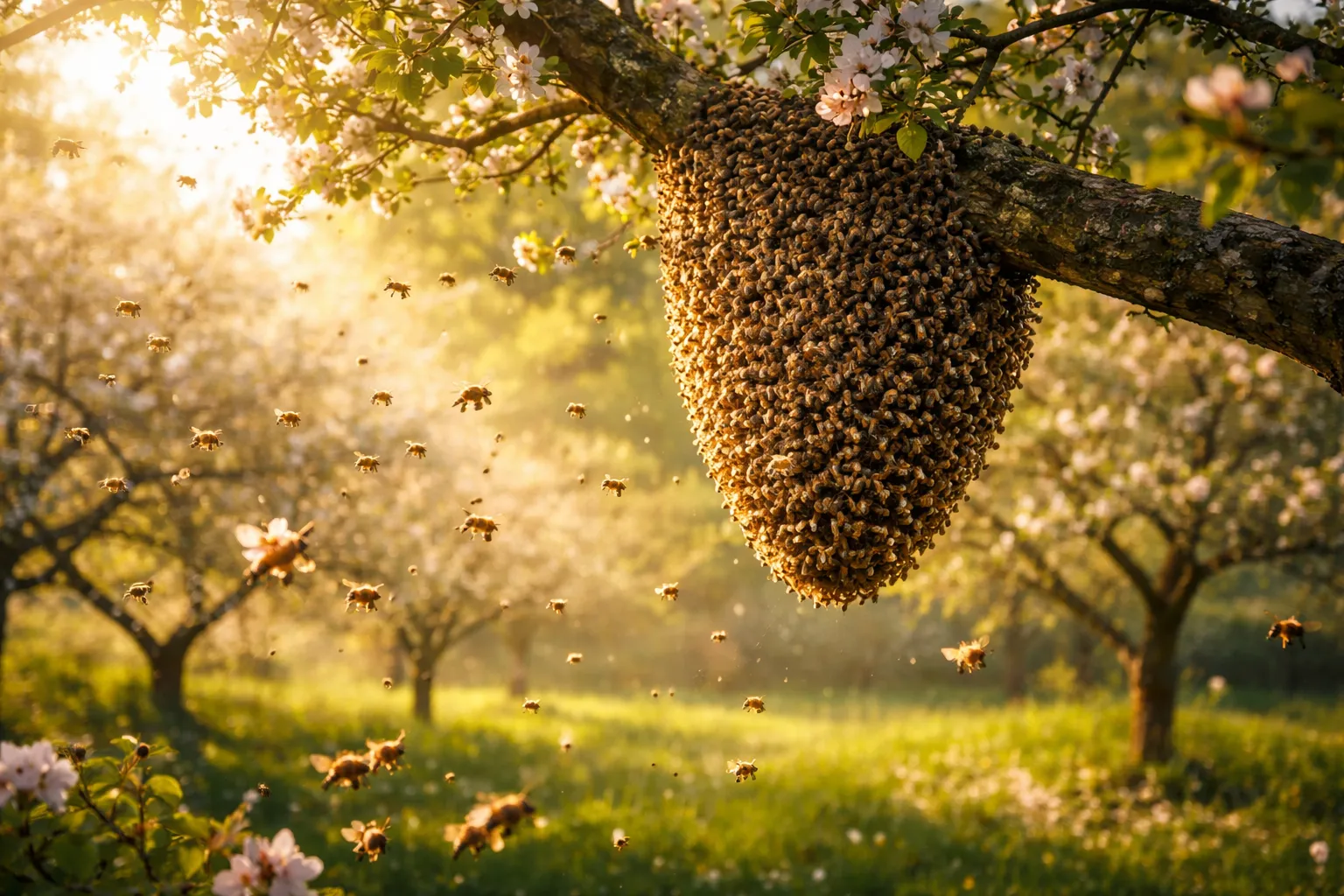
Every spring, a very old and amazing play happens in gardens and orchards all over the temperate world. There is a low, persistent hum in the air. A dark mass gathers on a tree branch, a rooftop, or a garden fence. It's a seething, pulsing cloud of tens of thousands of honeybees that are all working together for the same goal. To someone who doesn't know what's going on, it looks scary. A biologist would say that it is one of the most advanced forms of collective intelligence in nature.
The oldest rule in evolution is to reproduce or die, and swarming is how honeybees respond to it. A swarm is not a sign of aggression or disorder; it is a carefully planned event that takes weeks to prepare and is driven by genetic programming that has been honed over millions of years. Knowing why it happens and how it works gives you a glimpse into one of the most complicated social structures in the animal kingdom.
A Society Built on Biology
To comprehend swarming, it is essential to grasp the remarkable society within a beehive. A colony of Apis mellifera, the western honeybee, which is the type of bee that most European and North American beekeepers are familiar with, is not just a group of insects living together. Biologists call it a superorganism because it is a group of organisms that are so dependent on each other that the colony, not any one bee, is the real unit of survival and reproduction.
A healthy hive can have between 50,000 and 80,000 bees at the height of summer. Most of them are sterile female worker bees that do a lot of different things, like foraging, building comb, nursing larvae, keeping the temperature stable, guarding the entrance, and many more. Researchers at Heinrich Heine University Düsseldorf published a study in Science Advances in 2024 that found the genetic basis for this specialization. A gene called dsx controls whether a worker bee does a job in the colony and for how long, including group tasks like caring for larvae or finding food. The bees' DNA tells them how to divide their work, so they don't learn how to do it.
The queen, who is usually the only female in the colony who can have babies, is at the center of this society. She could live for three to five years and lay up to 2,000 eggs every day during the busiest time of year. There are a lot of male drones that only mate with virgin queens from other colonies and then die right away. It is a world where biological function rules everything, and personal ambition has no place.
The Trigger: When the Hive Does Too Well
In the Northern Hemisphere, swarming season lasts from April to June, which is exactly when spring flowers start to bloom. During the late spring and early summer, when a colony's population grows too large for its maternal nest, the colony goes through the swarming process to split itself up.
Overcrowding is the most likely cause. As the number of workers grows and the queen runs out of room to lay eggs, a lot of physiological signals start to move around the hive. Workers begin building unique, elongated "queen cells," which are larger, peanut-shaped cells that are usually found on the bottom edges of combs. These cells will be used to raise new queens. The presence of swarm cells with a larva and royal jelly is the best sign that the swarm impulse is in full swing.
After that, the workers do something that doesn't make sense: they start to undermine the queen. They cut down on her food, limit her movement, and slowly put her on what beekeepers call a "diet and exercise program." Before the swarm, the worker bees put the queen on a diet and exercise plan to help her lose weight so she can fly. A queen bee that is well-fed is too heavy to fly. She needs to lose weight before she can leave with the swarm.
The timing is exact and well-planned. As Adrien, a beekeeper from the Jura region of France, says, "Swarming happens just before the honey starts to flow." This happens when the brood is at its peak and the hive can't hold all the bees. The colony swarms at its strongest point, which gives the departing group the best chance of survival and the parent colony, which is left behind with plenty of food and developing queens, the best chance of survival as well.
The Departure: A Colony Splits Up
When the weather is right, like a warm, sunny morning with little wind, the swarm bursts out of the hive entrance in a loud, spiraling cloud. In the first swarm of the season, called the primary swarm, the old queen and about half of the workers leave the parental colony to start a new one. They leave behind a group of virgin daughter queens in their cells and the rest of the workers to keep the old colony going.
This 50-50 split is not by chance. If the parent colony took in too many workers, it would be doomed. If it took in too few, the swarm would be too small to survive its first winter. Natural selection has fine-tuned the proportions with ruthless efficiency. If you count the afterswarm, most wild honey bee colonies will swarm more than once in a season. Nature puts a lot of pressure on this behavior because the colonies that are best at repopulating an area after a decimation event are the ones whose genes will be passed down to the next generation.
At its best, a healthy swarm has between 20,000 and 30,000 bees. The cloud comes together surprisingly quickly after leaving the hive. It usually settles within 100 meters of the parent colony, either on a tree branch, a fence post, or any other convenient structure. This is a temporary place to stay, not a permanent home. The cluster hangs quietly, with the queen safe inside it. The real work of finding a house begins.
The Scout Bees: How Democracy Works
Scientists have been interested in what happens next for decades. It has been called one of the most complex examples of group decision-making in the animal kingdom.
Only a small number of the swarm, about 300 to 500 experienced older workers called scout bees, leave the group to look for good places to build nests in the area. Over the course of a few days, hundreds of scout bees look for 10 to 20 possible homes in hollow trees. Each site is then announced through a waggle dance, which shows where it is and tells other scouts about the find.
Karl von Frisch, an Austrian zoologist, was the first to figure out the waggle dance in the middle of the 20th century. He won the Nobel Prize for this work in 1973. The waggle dance is one of the most complex ways of communicating that we know of outside of human language. When a bee does a waggle run on the vertical surface of the comb, it shows the direction of a food source or nest site in relation to the sun. The length of the run shows how far away it is. Scouts are born with the ability to find the best nest sites for the needs of the swarm. Before reporting back, they check out potential homes for things like cavity size, entrance size, sun exposure, and safety.
The stronger the waggle dance, the better the housing site. This makes other scouts want to check out the site that was recommended. If they agree that it's a good choice, they also dance to promote the site and go back to it often. Scouts who are committed to different sites compete to get uncommitted scouts to join them. However, because they grade their recruitment signals based on site quality, support grows fastest at the best site.
In another important way, the process fixes itself. Scout bees are programmed to stop dancing after a certain amount of time, no matter how good their proposal is or how much support they get. This makes sure that the best site is chosen and that the balance of support doesn't shift toward a mediocre choice that entered the race early.
The colony gets a signal to leave when one site has enough scouts—about 15 bees physically present at the site at the same time. The swarm would leave for the site where they saw about 15 bees, even though some scouts were still dancing hard for the other site. In experiments where swarms had to choose between one better site and four that were only okay, they almost always chose the better site, even if it wasn't the first one they found.
Thomas D. Seeley, a professor of neurobiology and behavior at Cornell University and the author of Honeybee Democracy, has been studying this process for decades. Seeley looks into how evolution has improved honeybees' decision-making skills over millions of years. He finds that what works for bees can also work for people: any group that makes decisions should have people with similar interests and respect for each other, a leader's influence should be kept to a minimum, debate should be used, a variety of solutions should be looked for, and the majority should be relied on for a reliable resolution. Seeley says that the swarm is a smarter group for making decisions than a group of people.
The analogy goes even deeper. The way bees decide things is like how neurons in primate brains do it: both swarms and brains don't have a single unit that has an overview, but when many independent individuals give different pieces of information, the group makes the best decision.
The Last Move: Getting Around Without a Map
The departure happens almost right away after everyone agrees. A few scout bees who have been to the new site lead the whole swarm into the air. A new queen rises up in the parent colony, kills her sisters who are still developing into queens, goes on a mating flight, and becomes the matriarch of the nest.
Scientists call the scouts "streaker bees" because they fly quickly through the swarm cloud toward the new home, acting as moving directional signals for the mass of bees that have never left the cluster. The swarm moves together at speeds of 15 to 20 kilometers per hour, following these living signs to its new home.
Seeley's experimental work has shown what the swarm is looking for in a nest site: a cavity with an internal volume of about 40 liters, a small entrance facing south that is close to the ground (which is easier to defend and better insulated), and little to no existing infestation. In the wild, old hollow trees are still the best choice. They provide the insulation, volume, and protection that a colony needs to get through a temperate winter.
The Beekeeper's View: Healing and Duty
A swarm is both a chance and a problem for beekeepers. A beekeeper can set up a new hive, strengthen a weak colony, and, most importantly, help protect a species that is under a lot of pressure by recovering a wild swarm.
The capture method is very specific and needs the right tools. Adrien from the Jura says, "You take a hive and put it under the swarm, shake the branch, and let the swarm fall into the hive." The queen should go into the hive, and the others will follow on their own. Contrary to popular belief, a swarm at rest is not very aggressive. The bees don't have any honey stores or brood to protect, and they are calm because they are full of honey before they leave. Adrien says, "you never know," but protective gear is still very important.
If left alone, swarms will look for natural holes, like those in hollow trees, walls, chimneys, and roofs. The beekeeper who finds them gets more than just honey. Recent studies have shown that the invasive Tropilaelaps mercedesae mites can hitch rides on swarming honeybees, survive, and reproduce in new colonies. This means that controlling the recovery of swarms also stops parasites and diseases from spreading through areas where wild colonies aren't being controlled.
A Species in Danger
Keeping bee populations safe is important for more than just the taste of local honey. Honeybees pollinate about 80% of flowering plants. In the US alone, honeybees pollinate $15 billion worth of crops each year, including more than 130 types of fruits, nuts, and vegetables. All pollinators together provide up to $200 billion worth of ecological services each year.
But bee populations are under constant, multi-front stress. Pesticides and parasites killed 30.4% of the United States' bee colonies in 2023. This is 7.6 percentage points higher than the 13-year average summer loss of 22.8% that was first recorded in 2010.
Pesticides are still the most well-known danger. Neonicotinoids and pyrethroids, in particular, have been shown to have harmful effects in both laboratory and field studies, and they have been linked to declines in the populations of hundreds of wild bee species. A study from the University of California, Davis, found a compounding generational effect: bees that were exposed to neonicotinoids in both their first and second years of life had a population growth rate that was 72% lower than that of bees that weren't exposed. Neonicotinoids also stay in the environment long after they are first used. The consequences are dire; one application of pesticide can stifle a colony's growth trajectory over several seasons.
The parasitic mite Varroa destructor came to Europe from Asia in the 1970s and to North America by the late 1980s. It is now the most dangerous biological threat to managed honeybee colonies around the world. More than 40% of all U.S. colonies had varroa mites in the spring of 2022. The mite eats developing bee larvae and adult bees, which weakens their immune systems and spreads a number of viruses that make them sick, the most well-known of which is deformed wing virus. If you don't treat them, colonies usually die within two to three years of being infested.
The Asian hornet (Vespa velutina) is an invasive predator that came to France from China around 2004. It has since spread to most of Western Europe and recently made its way to the UK and parts of Southern Europe. It is a very effective honeybee predator that waits at the entrance to hives to catch foragers coming back. A small group of hornets can destroy an entire colony by constantly attacking it and stopping it from finding food. This has serious effects on honey production and the strength of the colony.
All of these problems are happening because of habitat loss and biodiversity loss. In the 1940s, there were five million managed honey bee colonies in the United States. Now, there are about 2.66 million. One of the main reasons for this decline is that agriculture has become more intensive, which has led to habitat destruction, the widespread planting of monocultures, the use of toxic pesticides, disease, and the loss of genetic diversity. Bees in monoculture landscapes are having a hard time finding food. They might be surrounded by flowering crops for a few weeks, but then they won't be able to find food for the rest of the season.
Climate change is adding a new level of difficulty. Several studies have shown that climate change is changing the behavior and phenology of honey bees. For example, records of swarming outside of the usual season have been rising sharply since 2020. The finely tuned synchronization between swarming season and peak nectar flow is in danger as seasons change and flowering times become less predictable.
Technology Takes Control
Researchers and beekeepers are turning to technology to deal with population pressures that can't be handled by just looking at them. Scientists at several different places have made acoustic and vibrational monitoring systems that can predict a swarm event days in advance. Machine learning algorithms that use vibration data from accelerometers inside hives can tell the difference between colonies that want to swarm and those that don't with more than 90% accuracy. They can even make predictions up to 30 days before the event. Aristotle himself said that a unique sound comes before a swarm. Modern technology has now been able to measure what he was hearing.
IoT-based remote monitoring platforms let beekeepers keep an eye on the weight, temperature, humidity, and sound signatures of their colonies in real time. This lets them act sooner and more precisely. In early 2023, the United States gave the green light to the first honeybee vaccine, which protects against American Foulbrood, a deadly bacterial disease. This was a big step forward in protecting managed colonies biologically.
What to Do When You See a Swarm
A swarm of bees hanging quietly on a tree branch is almost not dangerous to people who stay away from it and don't bother it. The cluster will usually stay in place for one to three days while the process of looking for a house goes on.
The best thing to do is to call a local beekeeper or your area's beekeeping group. Most beekeeping federations keep lists of swarm collectors who are willing to collect clusters for free. As Adrien points out, this is a chance to grow an apiary, help the local environment, and protect a species that is in danger. "It lets us treat them for Varroa mites and keep them safe from the Asian hornet as much as possible," he says. "We can't do these things with a colony living unmanaged inside a wall cavity."
It is strongly not recommended to try to remove a swarm without training. A docile cluster can become defensive if you bother it, and to successfully hive a swarm, you need to know how to catch a queen and have the right tools.
A Living Example of Humility
The honeybee swarm is quietly humbling in some way. In just a few days, without a central authority, a written plan, or one person knowing everything that is going on, tens of thousands of insects do what human committees often fail to do: they gather information from different sources, argue about it, reach a real consensus, and act on the outcome.
Thomas Seeley's decades of research have shown that the swarm's decision-making process chooses the best option about 80% of the time when tested against the best available nest sites. This is a success rate that is comparable to the best collective decision-making processes that humans have come up with. He says that the lesson is not just biological. It serves as a reminder that intelligence is not solely the domain of a singular intellect but can arise from the diligent accumulation of numerous modest, sincere inputs.
Bees are under a lot of stress from pesticides, parasites, habitat loss, and climate change. One of the most important changes that conservation science needs right now is for people to see swarms not as pests but as natural wonders that need to be protected.
If you spot a swarm, do not attempt to remove it yourself. Contact your local beekeeping association or federation, who will connect you with a trained swarm collector in your area.