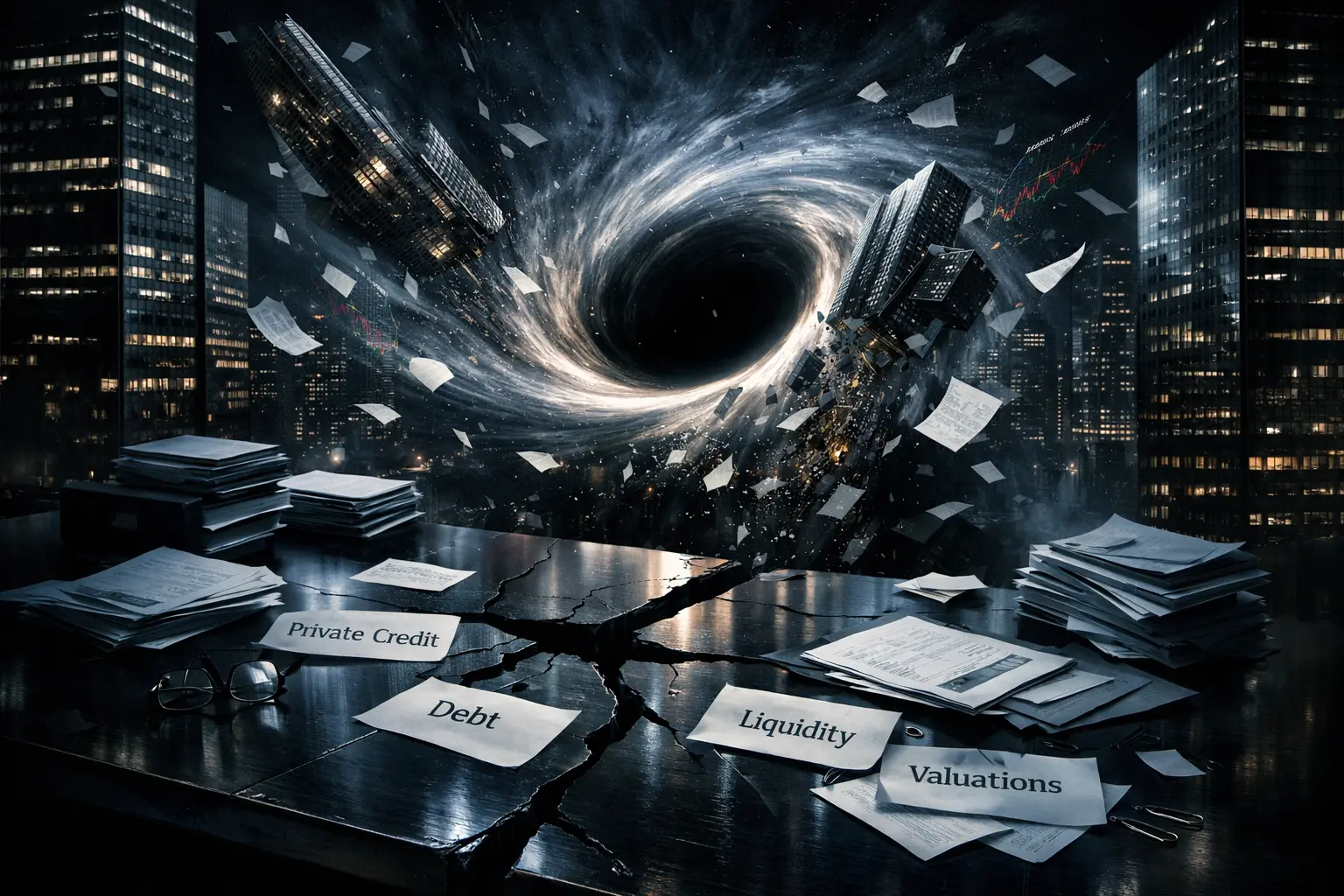
For a long time, people talked about private credit as the quiet revolution in the financial markets. A world that is deliberately kept out of the spotlight of banking rules, with high returns, low reported losses, and, it seems, manageable risk. Pension funds, insurance companies, and institutional investors put a lot of money into it. Alternative asset managers made empires out of it. People on Wall Street praised it as the thing that would change banking forever.
Those days are gone.
In the first few months of 2026, private credit will go through its first big stress test since it grew rapidly after 2008. The results are bad. Gates are closing, billions of dollars in market value are disappearing, and what used to look like a good thing is now clearly a bad thing. The question is no longer if there is stress in the system; it's if that stress can be kept from spreading to the rest of the economy.
The Growth of a $3 Trillion Hidden System
To comprehend the present disintegration, it is essential to grasp the magnitude of what was constructed.
After the 2008 Global Financial Crisis, regulators correctly decided that big banks had taken on too much risk without enough capital to protect themselves. The Dodd-Frank Act and Basel III standards from other countries made banks less likely to lend to risky borrowers, especially those with a lot of debt, middle-market, and sub-investment-grade corporate borrowers. They left a huge hole, and private credit filled it.
The market has grown from about $40 billion in 2000 to almost $3 trillion today, which is a 75-fold increase in about 20 years. Companies like Blackstone, Apollo Global Management, Ares Management, KKR, and Blue Owl Capital built huge platforms around this chance, managing hundreds of billions of dollars in private loans between them. The pitch was very appealing to investors: returns that were almost twice as high as those of government bonds, low reported default rates, and the promise of stability that wasn't tied to the ups and downs of public markets.
It worked for a while. Private lenders did very well in an environment with low interest rates, lots of global liquidity, and few corporate defaults. From early 2023 to January 2025, the biggest private equity and credit stocks saw what may have been the biggest rise in the history of financial services over a short period of time. KKR saw a return of more than 100%, while Blackstone, Ares, Apollo, and Blue Owl each saw rises of between 58% and 80%.
After that, the cyclone came.
The Redemption Wave: Cracks in the Foundation
Starting in September 2025, feelings changed, and they changed quickly. It wasn't just one big shock that caused the problem; it was a series of smaller cracks that, when put together, showed deep structural weaknesses.
When two little-known but heavily in debt American companies, Tricolor Holdings and First Brands Group, went out of business in the fall of 2025, it brought attention to the quality of private credit loans. Both companies had taken out a lot of loans from non-bank lenders and were later found to have committed fraud and had hidden debts that weren't on their balance sheets. On September 24, 2025, First Brands filed for bankruptcy. Its loans were worth about 11 cents on the dollar at the time. Big Wall Street firms like Jefferies and UBS were left with big risks.
The collapses were not very big on their own. But they asked a question that the industry had been avoiding for a long time: if these loans could hide fraud and inflated values, what else could be hiding?
A slow loss of trust followed, which showed up as a wave of requests from investors to cash out. The fallout timeline is very clear:
January 26, 2026: BlackRock takes 19% markdowns on TCP Capital Corp., wiping its NAV in a single quarter.
February 19, 2026: Blue Owl Capital permanently closes quarterly redemption gates on its $1.6 billion OBDC II retail fund after a 200% surge in withdrawal requests, promising to return only 30% of capital to investors over a 45-day window.
March 3, 2026: Blackstone faces record redemption requests on its flagship BCRED fund ($82 billion in assets), forced to lift its quarterly cap from 5% to 7.9% just to partly accommodate them.
March 6, 2026: BlackRock begins limiting withdrawals from its $26 billion HPS Corporate Lending Fund.
March 11, 2026: Morgan Stanley and Cliffwater cap redemptions across funds managing $8 billion and $33 billion, respectively.
March 19, 2026: Stone Ridge's Alternative Lending Risk Premium Fund gates redemptions entirely after being overwhelmed with withdrawal requests.
March 24–25, 2026: Ares Management caps redemptions in its $10.7 billion Strategic Income Fund at 5%, after withdrawal requests surge to 11.6%. Apollo announces similar measures. Ares, Apollo, KKR, and Blackstone shares all fall 3–5% in a single session.
According to the Financial Times, the biggest private credit managers, like Blackstone, BlackRock, Morgan Stanley, and Cliffwater, all got more than $10 billion in redemption requests in the first quarter of 2026. These companies said they would only meet about 70% of those requests.
There has been a lot of damage to the market. Apollo fell 41% from its peak, Blackstone fell 46%, and Ares and KKR both fell 48%. Blue Owl went down by two-thirds. Fortune says that the total wipeout has cost the market more than $265 billion in value.
What Investors Don't Know About the "Black Hole" of Opacity
Regulators and economists have long warned about a structural problem at the heart of this crisis: private credit works in almost complete darkness.
Private credit loans are different from public bond markets because borrowers and lenders talk directly to each other about the terms of the loans. They don't make their terms public. They use internal models to figure out how much something is worth instead of looking at market prices. This is called "marking to model." An SEC filing that came out in late February 2026 showed this problem very clearly: BlackRock cut the value of a $25 million loan to a company called Infinite Commerce from full par value to zero in just a few months, with no signs of stress before that.
This lack of transparency creates a dangerous information gap. People who put money into private credit funds often don't know exactly what they own or how much their assets are really worth. Many of the loans have "covenant-lite" (cov-lite) terms, which are agreements with fewer financial restrictions that make it harder for lenders to keep an eye on how borrowers are doing. IESE Business School research shows that hedge funds and private equity firms are now mostly giving out cov-lite loans, which have looser "incurrence" covenants instead of strict maintenance covenants.
The problem of opacity gets worse with the rise of private letter ratings, which are evaluations that only the issuer and a few investors can see, not the whole market. In October 2025, the Bank for International Settlements (BIS) said that ratings on private credit assets held by US insurers may have been systematically inflated. This could have led to fire sales during times of stress, similar to what happened with the subprime mortgage crisis. In November 2025, UBS Chairman Colm Kelleher went even further, saying that insurance companies looking for better ratings on private credit assets were engaging in "ratings arbitrage," which was the same thing that made the 2008 disaster worse.
When people lose faith in a system that is this unclear, liquidity doesn't slowly go away; it falls apart. The feedback loop is brutal: media reports of redemption pressure lead to more withdrawal requests, which lead to more gates and markdowns, which cause more alarm. It looks like a modern bank run, but there is no deposit insurance or a central bank lender of last resort to back up the money.
The End of the "No Loss Dream"
For a long time, private credit was known as an asset class where defaults were rare, losses were kept to a minimum, and returns were almost certain. CNBC has called this idea a "fantasy," and the numbers are starting to back it up.
Morgan Stanley thinks that the rate of defaults in private credit direct lending could rise to 8%, which is much higher than the historical average of 2–2.5%. Morgan Stanley says that the pressure is focused on certain areas, with software companies being the most vulnerable. They make up about 26% of private credit direct lending exposure. The worry is that the quick rise of agentic artificial intelligence could cause major, long-lasting problems in the software-as-a-service (SaaS) industry, destroying business models that private lenders put a lot of money on just a few years ago.
However, the official default numbers probably don't show how bad things really are. The industry has relied heavily on a set of tools that put off rather than solve money problems:
Payment-in-kind (PIK) deals, in which interest is added to the principal balance instead of being paid in cash.
Loan extensions—pushing back the due dates to give you more time.
"Amend-and-pretend" restructurings, in which terms are changed to avoid a formal default.
These mechanisms act as a "release valve," preventing outright failures in the short term while silently accumulating risk for the future. One analyst told CNBC, "For the real economy, this means that capital gets stuck in restructurings, making it harder to get loans in the future." The cost isn't avoided; it's put off, and interest builds up.
The Interconnected Web: How "Private" Became Systemic
The most dangerous thing about the private credit crisis might not be the total amount of possible losses, but how much the sector has become linked to the rest of the financial system.
The Federal Reserve Bank of Boston has written about the process in great detail: bank loans have mostly been used to fund the growth of private credit. Banks have lent private credit funds hundreds of billions of dollars through credit lines and other means. These banks don't directly make or hold the private credit loans; instead, they lend money to the funds that do. However, they are still at risk of losing money on those loans. According to the Boston Fed, this means that banks "still have indirect exposure to the credit risk of private credit loans even though they don't directly make or hold those loans."
The Moody's study of Federal Reserve data is interesting: lending to non-bank financial institutions (NBFIs), which includes private credit funds, has been the fastest-growing type of loan in US commercial banks. By mid-March 2026, NBFIs made up 11.6% of all US bank loans, and the 25 largest US domestic banks made up an even higher 16.2%. That share has gone up by almost three times since 10 years ago.
In the meantime, the pool of investors in private credit has grown far beyond just smart institutions. Pension funds, insurance companies, sovereign wealth funds, and more and more retail investors through semi-liquid "evergreen" vehicles all have a lot of money at risk. Before its crisis, Blue Owl got 21% of its fee-related income from wealthy individual investors. Blackstone's BCRED fund, which has $48 billion in assets, brings in about 13% of the company's total fee income. These are not small numbers.
A Moody's Analytics study from June 2025 found that the growth of private credit is making the financial system "more interconnected," and this interconnection could "disproportionately amplify a future crisis." Researchers at Harvard Kennedy School came to the same conclusion: even though private credit funds are still smaller than banks, "the direction of travel points toward growing systemic importance" as the sector grows. Moody's found that during times of stress, especially COVID-19, business development companies (BDCs) moved in the same direction as systemic risk factors much more often. This trend has continued to be high since the pandemic.
Is this 2008? Reasons to be careful and worried
It is impossible not to compare things to the 2008 Global Financial Crisis, but these comparisons need to be made with care.
There are significant structural disparities that contest the likelihood of a comprehensive systemic collapse. Private credit funds are usually not as heavily borrowed as investment banks were before 2008. The 2025 Federal Reserve stress tests showed that even in the worst-case scenario of a severe recession, losses from NBFI exposures were manageable. For example, the loss rates on loans to financial institutions were about 7%, and large banks had capital ratios that were well above the minimums set by regulators. Kenneth Rogoff, an economist at Harvard, said, "The main difference between this and 2008 is that you had a lot of leverage on similar types of assets that were fully available to whoever owned them." That recourse leverage is structurally less today.
In addition, most private credit capital is still in traditional closed-end structures that are backed by institutional investors with long investment horizons. These structures are less likely to be affected by the kind of mass panic that can cause a bank or money market fund to fail.
But the similarities with 2008 go deeper than that. The main problem with both crises is the same: lack of transparency makes it hard for markets to accurately price risk. In 2008, the problem wasn't just that mortgage-backed securities had bad loans; it was also that no one knew where those loans were, how much they were worth, or who was ultimately responsible for the risk. Today, private credit has a similar lack of information. The loans are not public. The valuations are based on models. The ratings might be too high. No one has ever fully mapped out how private credit funds, banks, insurance companies, and pension funds are all connected.
Natasha Sarin, president of the Budget Lab at Yale University, said, "It's like a yarn that you start to pull and you're worried that it's both coming apart and connected to all the other parts of the financial system." I'm worried that none of us really understand how cascading downturn risk could happen.
The Road Ahead: Rules, Changes, and Accountability
The current episode is forcing a reckoning, not just for the funds that are in trouble right now, but also for the regulatory structure that let this shadow system grow mostly unchecked for almost twenty years.
Regulators have started to do something, though it's too late. Since December 2024, US bank regulators have told commercial banks that they need to give more information about their exposure to non-bank financial institutions. The SEC is currently reviewing its rules for private credit disclosures. Researchers at Harvard Kennedy School have asked regulators and central banks to widen the "regulatory perimeter" to include large private credit funds, close gaps in transparency by making reporting requirements stricter, and take into account the rapid growth of non-bank credit in macroprudential policy.
Consolidation seems likely within the industry itself. Smaller private credit shops that are too heavily leveraged may have to merge with bigger managers who have better balance sheets. The VanEck Alternative Asset Manager ETF, which is a proxy for the sector, has been trading close to its 52-week lows. Some funds won't be able to stay the same.
The strongest players will probably make it through the storm. Apollo, Blackstone, and Ares are big and diverse enough to handle redemption pressure that would kill smaller competitors. But even they have to face a truth that the industry has been putting off for a long time: there is no such thing as an asset that is not liquid but has a promise to be liquid.
The first real "at scale" liquidity test for private credit is now going on, as UBP's Nicolas Roth put it. What it shows about the quality of loans, the integrity of valuations, and how deeply connected it is to the rest of the financial system could very well determine what the next financial crisis looks like.
And in the markets, problems don't usually stay separate. Private credit, no matter how "private" it may have seemed in the past, has grown too big and too complicated to fail quietly.