The eleventh name on the list is the oldest one. Amy Eskridge died in Huntsville, Alabama, on June 11, 2022. She was 34. The death was recorded as a self-inflicted gunshot wound, though no detailed report from local police or the Madison County medical examiner has ever been released to the public. For nearly four years her name circulated only in small online communities devoted to UFO research and unconventional propulsion. This week she became the eleventh entry on a list that has reached the White House briefing room, the Bernalillo County Sheriff's Office, the FBI, and the Department of Energy's National Nuclear Security Administration.
Donald Trump, asked about the cluster of cases on Thursday, said he had "just left a meeting" on the subject and promised an answer within roughly a week and a half. "I hope it's a fluke, but we'll find out," he told reporters. Press Secretary Karoline Leavitt followed up on X with a statement that the White House would conduct a review of all cases "to identify potential commonalities" and that "no aspect will be left unexamined." The NNSA confirmed to Fox News Digital that it is reviewing reports concerning employees at its laboratories, plants, and sites.
Online, the list is presented as a single phenomenon. In reality it is at least three different stories braided together, and Eskridge's case sits at the strangest end of all of them.
The list, sorted into what we actually know
Start with the cases that have working investigations and named suspects. Nuno Loureiro, the 47-year-old director of MIT's Plasma Science and Fusion Center, was shot in the foyer of his Brookline, Massachusetts, apartment building on the evening of December 15, 2025. He died early the next morning at Beth Israel Deaconess Medical Center. Within three days, Massachusetts and Rhode Island authorities tied his murder to Cláudio Manuel Neves Valente, a Portuguese national who had carried out a mass shooting at Brown University two days earlier. Valente had attended Instituto Superior Técnico in Lisbon with Loureiro between 1995 and 2000, graduating first in the class ahead of him. The Connecticut State Police Forensic Science Lab matched a firearm recovered with Valente's body to the weapon used in Brookline. Valente killed himself in a New Hampshire storage unit. The case is closed in the procedural sense. The motive appears to be a personal grievance carried for a quarter of a century, not a state actor or corporate hit.
Carl Grillmair, a 67-year-old Caltech astrophysicist who had spent three decades on Hubble, Spitzer, and the NEOWISE missions, was found shot to death on the porch of his rural home in Llano, California, on February 16, 2026. A 29-year-old man named Freddy Snyder was arrested and charged with the murder, along with separate carjacking and burglary charges involving his own relative. Snyder had reportedly been seen trespassing on Grillmair's property in the weeks before the shooting. Investigators do not believe the two men knew each other.
Two scientists. Two solved homicides. Two killers with no connection to each other, no connection to nuclear or aerospace secrets, no plausible employer beyond their own pathologies. These cases are on the list because the victims were scientists. Stripped of that, they belong to the same category as any other American shooting death.
The next category is harder. Frank Maiwald, a 61-year-old principal researcher at NASA's Jet Propulsion Laboratory, died on July 4, 2024, in Los Angeles. His obituary records the date and place but not the cause. Michael David Hicks, a JPL research scientist who worked on the DART asteroid deflection mission and Deep Space 1, died on July 30, 2023. Jason Thomas, a pharmaceutical researcher at Novartis working on cancer treatments, died on March 17, 2026. None of these deaths has been publicly linked to foul play. They appear on the list because of where the men worked.
Then there are the genuine puzzles, and they cluster in two places.
The first cluster is northern New Mexico, around Los Alamos and Albuquerque. Anthony "Tony" Chavez, a 78-year-old retired Los Alamos National Laboratory employee, walked out of his Los Alamos home on or around May 4, 2025. He left his wallet, keys, and phone behind. His banking activity stopped on May 5. Cadaver dogs have searched Pueblo Canyon. He has not been seen since.
Eight weeks later, on June 26, 2025, Melissa Casias, a 53-year-old administrative employee at the same lab, vanished from Taos County. Earlier that day she had picked up a sandwich and dropped it off for her daughter. When her family came home they found her car, purse, keys, and both her personal and work phones inside the house. The phones had been factory reset. Her family insists she did not leave voluntarily. She had been preparing to help care for her mother during an upcoming surgery.
Steven Garcia, 48, a contractor at the Kansas City National Security Campus's Albuquerque branch, which fabricates non-nuclear components of nuclear weapons, walked out of his home on Cattail Court SW in late August 2025 with a handgun. Wallet, phone, and keys stayed behind.
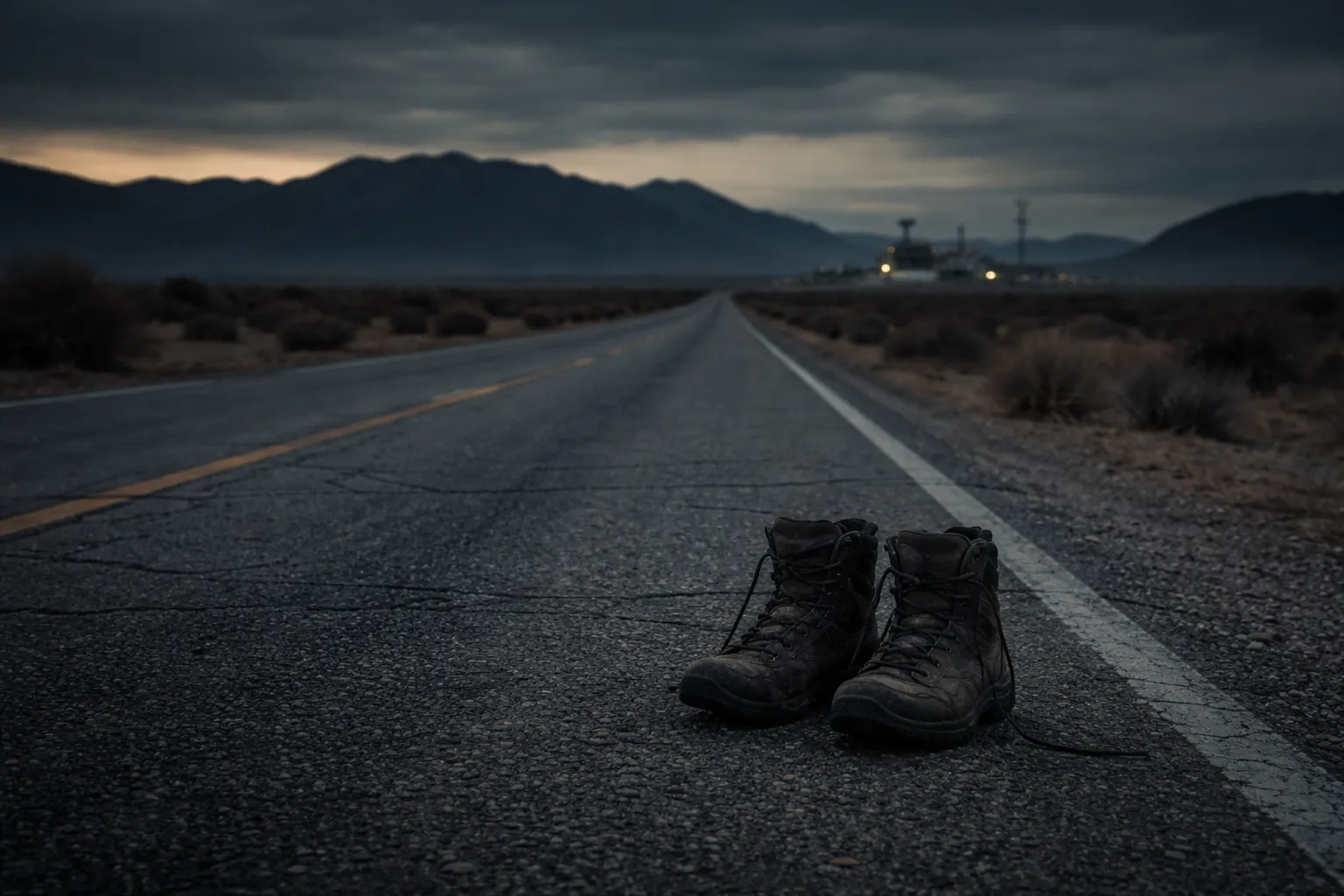
And then, on February 27, 2026, retired Air Force Major General William Neil McCasland, who had commanded the Air Force Research Laboratory at Wright-Patterson Air Force Base, walked out of his Albuquerque home some time between roughly 11:00 a.m. and noon, while a repairman was leaving and his wife was at a medical appointment. He took his hiking boots, a wallet, a .38-caliber revolver in a leather holster, and a red backpack. He left his phone, his prescription glasses, and his wearable devices on a counter. A gray Air Force sweatshirt, with no blood on it, was found 1.25 miles east of the house eight days later. The Bernalillo County Sheriff's Office has canvassed more than 700 homes. They have no evidence of foul play.
McCasland's wife, Susan McCasland Wilkerson, has been blunt. She told NewsNation in a phone call that she believes her husband "planned not to be found." She told CNN her husband had recently described experiencing "mental fog." She has dismissed the UFO speculation directly: "Neil does not have any special knowledge about the ET bodies and debris from the Roswell crash stored at Wright-Patt." Her husband retired thirteen years ago, she pointed out. "It seems quite unlikely that he was taken to extract very dated secrets from him."
Set against that, the local picture: four people with some level of nuclear-program access, all from the same eleven-month window, all from the same corner of New Mexico, all leaving their phones at home. Two of them were carrying firearms when they walked away. The Bernalillo County Sheriff's Office told Newsweek it has "not developed evidence establishing that Mr. McCasland's disappearance is connected to his classified work" and has no verified information tying it to the other missing-persons cases. That is not the same thing as saying there is no pattern. It is the institutionally cautious way of saying we cannot prove there is one.
The second cluster involves NASA's Jet Propulsion Laboratory in Pasadena. Monica Jacinto Reza, a 60-year-old aerospace engineer and JPL's Director of Materials Processing, vanished while hiking the Mount Waterman trail in the Angeles National Forest on June 22, 2025, around 9:10 a.m. She was with two experienced companions on a well-traveled route. One of them was about thirty feet ahead. He turned, saw her smile and wave that she was fine, turned back to keep walking, and when he looked again moments later, she was gone. No body, no clothing, no phone signal, no trace. Search and rescue, K-9 units, and helicopters found nothing. Reza had co-invented Mondaloy, a nickel-based superalloy used in the AR1 rocket engine designed to replace Russian-made RD-180s. Her materials work had been funded in part by the Air Force Research Laboratory, the same organization McCasland led until his retirement. Two of the three JPL deaths on the list (Maiwald and Hicks) are also Reza-adjacent.
The Reza disappearance is the one case on the list that, even on its own, would be hard to explain. People do not vanish from a mountain trail in front of an experienced hiking companion in clear daylight. They fall, they twist an ankle, they get lost, and they are usually found, alive or otherwise. Reza was not.
Eskridge
Amy Catherine Eskridge graduated from the University of Alabama in Huntsville with a double major in chemistry and biology. She went on to interdisciplinary graduate work in electrical engineering, chemistry, physics, and genetic engineering. With her father, Richard Eskridge, a retired NASA engineer who had worked at Marshall Space Flight Center, she founded a small company called HoloChron Engineering and a nonprofit called the Institute for Exotic Science. The institute described its mission as research into experimental propulsion, frontier physics, and what Amy openly called antigravity. After her death the website went dark. It has not come back.
There is a piece of context that has not been mentioned in any of the Daily Mail or Newsweek coverage of her case, and it matters. Huntsville is the historical American capital of antigravity research. In the late 1990s, Ning Li, a physicist at the University of Alabama in Huntsville, was working on theoretical models for gravitomagnetic fields generated by spinning superconductors. NASA's Marshall Space Flight Center, just down the road, ran something called Project Delta G as part of its Breakthrough Propulsion Physics Program. The program operated from 1996 to 2002 on a total budget of roughly $1.2 million and tried to replicate the work of the Russian physicist Eugene Podkletnov, who had reported in 1992 that a rapidly rotating superconducting disc cooled in liquid nitrogen reduced the weight of objects placed above it by about two percent. BAE Systems ran a parallel project in the United Kingdom called Greenglow. Boeing reportedly ran one called GRASP, for Gravity Research for Advanced Space Propulsion.
None of these efforts produced a replicable result. The Podkletnov effect has never been confirmed by an independent laboratory in three decades of trying. NASA's program was shut down in 2002 when its parent program was reorganized and all research below technology readiness level 3 was canceled. Antigravity, in the strict sense of a force that cancels gravitational attraction, is not a recognized phenomenon in mainstream physics.
This is the field Eskridge inherited. She grew up inside it. Her father had worked on related concepts at NASA. She and her father presented at conferences for fringe-physics audiences. A 2018 HoloChron presentation reportedly described historical and modern experiments in gravity modification, including alleged classified programs producing triangular antigravity craft known in UFO circles as the TR-3B. By 2020 she was telling the YouTube interviewer Jeremy Rys that NASA approval would be required before she could publish what she described as "novel foundational work" on antigravity.
In that same interview she said the things that, after her death, took on a different weight. "We discovered anti-gravity, and our lives went to hell, and people started sabotaging us. It's harassment, threats. It's horrible." And the line that has been quoted in nearly every piece written about her since Wednesday: "If you put yourself out there publicly, at least someone will notice if they cut your head off. If you do it privately, they'll bury you. They'll burn your house down while you're sleeping, and it won't even make the news."
She also said this, which has been quoted less: "I have to publish because it's going to get worse and worse until I do." And: "I need to disclose soon, man. It's like escalating."
Two years later she was dead of a gunshot to the head. The Huntsville Police Department has released no investigative report. The Madison County coroner's office has released no public findings. Her father has not made statements to the press. The institute went dark.
In the years since, the case has been kept alive by a particular subset of the UFO community. The journalist Michael Shellenberger told a public hearing on Unidentified Anomalous Phenomena that Eskridge had been "murdered by a 'private aerospace company' in the US because she was involved in the UAP conversation." The retired British intelligence officer Franc Milburn, speaking on the late-night radio show Coast to Coast AM, described what he characterized as a campaign of harassment and "directed energy weapon attacks" intended to either stop her work or debilitate her until she could not continue it. Neither claim has been substantiated by any law enforcement agency. Neither has been formally rebutted, either, because no agency has publicly engaged with the case at all.
Here is what is true. Antigravity research, as a serious physics enterprise, has not produced replicable results. The most famous claimed effect has resisted independent confirmation since 1992. The Pentagon's interest in unconventional propulsion, where it exists, has migrated under the AARO and UAP framework rather than into private corporate efforts that might want to silence inconvenient researchers. The simpler reading of Eskridge's case is the one that her own words point toward, gently, if read without the conspiracy filter: a brilliant, isolated researcher in a fringe field, working with very little institutional support, increasingly convinced she was being targeted, telling a YouTube audience that her life was in danger.
That reading is also a tragedy and not necessarily a smaller one. People who become convinced they are under invisible surveillance and that powerful enemies are closing in on them sometimes are. More often they are unwell. The pattern Eskridge described, where reporting harassment publicly is the only protection against it, is the same pattern described in clinical literature on persecutory ideation. So is the escalating sense that disclosure must happen soon, that pressure is mounting, that the walls are closing in.
The Huntsville Police Department's silence on her case is not necessarily sinister. Suicides are not normally the subject of detailed public reports, particularly when the family does not request one. The fact that no investigative documents have been released for nearly four years is consistent with a closed case that the local department considers settled. It is also consistent with other readings, which is why the case has refused to die.
What makes this week different is not new evidence in the Eskridge case. There is none. What is different is that her case has been welded onto a longer list, several entries of which are genuinely inexplicable, and the resulting composite has reached a point where the President of the United States is talking about it from the White House lawn.
What a serious review would actually look at
The cases worth investigating are not the same as the cases generating headlines. The Loureiro and Grillmair murders are solved and unrelated to anything classified. The JPL deaths are unexplained but unremarkable on their face. The cases that demand answers are Reza, Chavez, Casias, Garcia, and McCasland. Five people, in roughly eleven months, four of them in a single corner of New Mexico, three of them with phones-left-behind disappearances that follow nearly identical scripts. That is the cluster. That is what the FBI, if it gets serious, will spend its time on.
The Eskridge case is something else. It is the case that the list needed to look longer. It is the case that gives the broader story its UFO valence and its conspiratorial momentum, because it involves a young woman who said on camera that she expected to be killed and then died by what was officially recorded as her own hand. It is the kind of case that, in the absence of any public investigative file, will be argued about for as long as anyone is still arguing about TR-3Bs and Roswell.
A reporter named Sherman McCorkle, a longtime friend of Neil McCasland, told NewsNation what may turn out to be the most honest sentence anyone has uttered about any of this. He was talking about the general, but the line travels. "I'm just totally mystified. I have no understanding whatsoever how you can walk out your front door and vanish. Nothing makes any sense."
That is not yet evidence of a conspiracy. It is just the first thing an honest investigator says before the work begins.