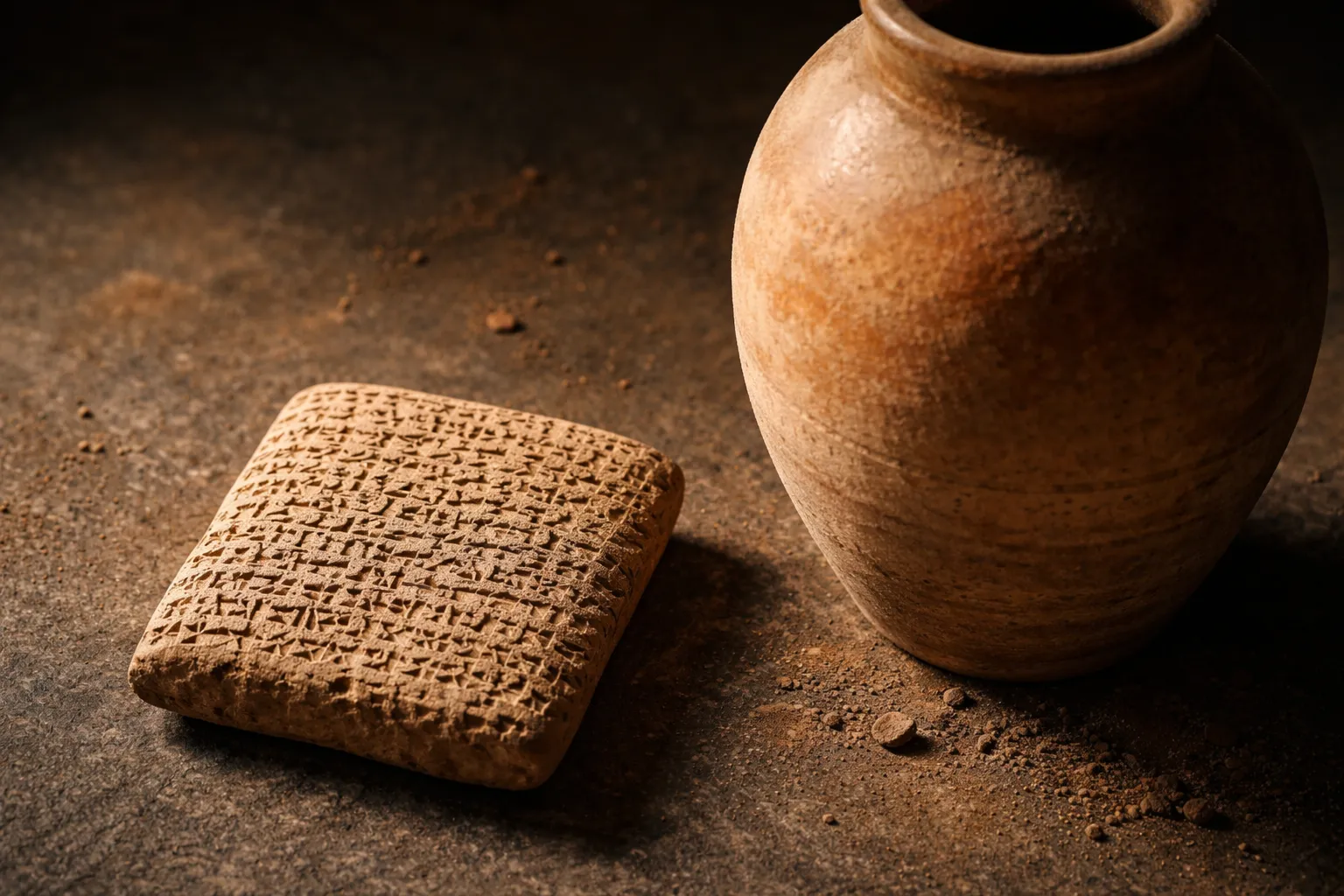
A small clay tablet, no larger than a smartphone, has been sitting quietly in the storerooms of the National Museum of Denmark for the better part of a century. Nobody knew what it said. Now somebody does, and the answer is gloriously ordinary: 16 liters of premium beer and 55 liters of the regular stuff, supplied by a man called Ayyali to a crew of workers in the southern Mesopotamian city of Umma around 2000 BCE.
That is roughly the same volume of beer a small modern bar might pour on a quiet Tuesday. It is also, very probably, a single day's wages.
The tablet is one of several hundred recently catalogued by a team from the University of Copenhagen and the National Museum under a project called Hidden Treasures: The National Museum's Cuneiform Collection. Led by Assyriologist Troels Pank Arbøll, the four-year effort has produced the first complete inventory of Denmark's cuneiform holdings, including line drawings, transliterations, and digital scans now folded into the international Cuneiform Digital Library Initiative. The project's catalog runs to a substantial volume from Museum Tusculanum Press. The headlines, predictably, went to the beer.
There is a reason for that, and it is not simply that beer makes a fun story. The Umma receipt is a tiny, perfectly preserved fragment of evidence about a system that built the world's first cities, fed their populations, and gave us the very technology of writing itself. Mesopotamian scribes did not invent cuneiform to compose poetry or record the deeds of kings. They invented it to keep track of beer.
Brewing as bureaucracy
The conventional story of writing's invention, the one that gets repeated in textbooks, treats it as a leap of human genius. The reality, as the British Museum's curators are fond of pointing out, is that the very earliest tablets we have, from Uruk in southern Iraq around 3200 BCE, are essentially spreadsheets. A pictogram of a human head tipped toward a bowl meant to eat, or ration. A conical jar with wavy lines inside meant beer. Around them, scratched into the wet clay, were tally marks recording how much was owed to whom.
Writing did not begin with literature. It began with accounts payable.
By the time the Umma tablet was inscribed, around the end of the third millennium BCE during the period scholars call Ur III, this proto-writing had matured into a sophisticated administrative apparatus. The Ur III dynasty (circa 2112 to 2004 BCE) ran one of the most micromanaged economies the ancient world ever produced. Around 64,500 cuneiform tablets from this roughly forty-year period have been published, and tens of thousands more sit in museum drawers awaiting attention. Most are not epics or hymns. They are receipts, ration lists, work assignments, and inspection reports of the kind a modern HR department would recognize instantly.
The Umma province, where the Danish tablet originates, was a particularly busy node in this system. Excavations and, less honorably, looting at Tell Jokha, the ancient site of Umma, have produced something like 30,000 tablets from a governor's archive. They record everything from the weight of wool issued to weavers, to the daily output of plowing teams, to the amount of barley owed by one official to another for the inspection of a fishpond.
Against this background, Ayyali's beer delivery starts to look less like a curiosity and more like a single line in a vast ledger. The "high-quality beer" and "regular beer" categories were not casual descriptors. Sumerian and Akkadian texts distinguish between at least three grades of strength, often translated as ordinary, good, and very good, with alcohol content ranging up to about five percent. There were dark beers, golden beers, sweet dark beers, red beers, and strained beers. Babylonian sources later list more than seventy varieties. Brewers were skilled artisans whose work was so socially valuable that the trade had its own patron deity.
The economics of a liquid wage
Here is where the receipt becomes interesting beyond its novelty. If you accept the standard reading of Ur III labor records, where workers received daily rations of around three to six liters of barley equivalent, then 71 liters of beer is roughly what you would distribute to a crew of about a dozen men for a single day's work. Maybe fifteen, depending on grade and how the rations were calibrated. The numbers fit.
What were they doing? The tablet does not say, but Umma during this period was a hive of construction, irrigation, weaving, and forestry. Around 2039 BCE, an inspection conducted under the authority of A'a-kala, governor of Umma, listed sixty foresters organized into thirty teams under three foremen, each man ranked and rationed accordingly. A nearby site called Garshana, partly a royal building project under the Ur III king Shu-Sin, has yielded daily reports written down by scribes every evening, an almost unprecedented level of administrative immediacy. The hired women on that project earned three liters of barley a day. Hired men earned five or six. Forewomen, who supervised crews twice the size of the men's, were paid more than their male equivalents.
Read that last sentence again. It is from 4,050 years ago.
The beer-as-wage system was not unique to Mesopotamia. In Egypt, a Bronze Age workman's village called Deir el-Medina, home to the artisans who decorated the royal tombs of the Valley of the Kings, kept meticulous records of grain rations distributed by scribes on the 28th of each month. The grain came as emmer wheat for bread and barley for beer. When rations were late, the workers struck. The earliest recorded labor stoppage in human history happened in 1158 BCE, in the 29th year of the reign of Ramesses III, when builders downed tools, marched to the funerary temple complexes, and staged a sit-in until they were paid in beer, oil, vegetables, and fish. We are hungry, the strike record reads, for eighteen days have already elapsed this month.
The biomolecular archaeologist Patrick McGovern, who has spent decades extracting the chemical residues of ancient drinks from potsherds, has noted that pyramid workers received four to five liters of beer per day. Without it, he argues, the pyramids might not have been built.
This sounds like a joke. It is not.
Mesopotamian beer was almost nothing like the carbonated lager you will find in a fridge today. It was thick, cloudy, and unfiltered. People drank it through long reed straws to avoid the layer of sediment, husks, and floating grain that settled at the top and bottom of the vessel. Recreations based on the Hymn to Ninkasi, the famous 1800 BCE Sumerian poem to the goddess of brewing translated by the late Miguel Civil at the University of Chicago, suggest a beverage of about 3.5 percent alcohol, dry, slightly sour, and somewhere between hard cider and a flat wheat beer in character. Modern brewers, including Anchor Brewing's Fritz Maytag, who attempted a recreation in the early 1990s, found that the resulting drink did not keep well. It was meant to be consumed within days.
But here is the point. Sumerian beer was, calorie for calorie, food. The grain was not strained out at the end. A worker drinking five liters of barley beer was consuming the equivalent of a substantial meal in liquid form, plus B vitamins generated by the fermentation, plus enough alcohol to take the edge off the day, plus, critically, water that was safer than what came out of a canal in the Iraqi summer. A Sumerian proverb from this period, quoted by the historian Stephen Bertman, says simply: He who does not know beer, does not know what is good.
What Ayyali's tablet is not telling us
There is a temptation, when looking at the Umma receipt, to read it as an act of generosity. Look how kindly the Mesopotamians paid their workers. Look how civilized, how convivial, that the labor of building a city should be rewarded in beer.
It was not exactly that. The Ur III state was, by any reasonable measure, an administrative machine of extraordinary intrusiveness. It tracked the labor of men, women, and children with a precision that would not be matched in Europe until the rise of the early modern bureaucracies four thousand years later. Slaves were rationed differently from free workers. Workers were graded into A-class, B-class, and lower categories. Failure to meet output targets carried penalties. Debts were enforced. The system that produced Ayyali's beer receipt also produced lists of personnel by name and physical description and reckoned the value of a missing day's work in liters of barley owed back to the institution.
The beer was not a kindness. It was a wage, denominated in the most fungible commodity the early urban economies had: fermented grain. It went out with the same paperwork that tracked everything else.
What the tablet really records, then, is something far stranger and more important than a beer tab. It is a snapshot of the moment when human beings figured out how to organize thousands of strangers into a functioning city by reducing their labor, their bellies, and their loyalty to a set of marks pressed into a piece of mud. Everything that follows, from the Roman annona to the Federal Reserve, descends from this. The receipt is the system in miniature.
The other things in the boxes
The beer tablet, for all the attention it has attracted, is not the most spectacular thing the Danish project has uncovered. That distinction probably belongs to a school text, a copy of a Sumerian king list mentioning rulers from the end of the third millennium BCE. Other versions of this list mention Gilgamesh, the priest-king of Uruk who became the hero of the world's earliest surviving epic. The presence of a copy in Copenhagen is, in Arbøll's words, quite spectacular. It adds a small piece of evidence to the long-running debate over whether Gilgamesh was a real historical figure who got mythologized or a mythological figure later inserted into a historical king list.
There are also tablets from the ancient Syrian city of Hama, biblical Hamath, which a Danish expedition excavated in the 1930s. In 720 BCE, the Assyrians sacked Hama and carried off most of its written records to their capital at Assur. In their hurry, they left behind a small group of clay tablets, which the Danish team recovered and which now sit in the museum's collection. These are nearly three thousand years old and contain medical prescriptions and magical incantations, recipes against witchcraft intended to protect Assyrian kings from supernatural harm. As Arbøll has noted, almost no other tablets of this kind have been recovered from the same region and period. The Assyrian raiders, in a small mercy to scholarship, were not thorough.
Then there are letters from Tell Shemshara in northern Iraq, excavated by a Danish team in 1957. These include correspondence between a local chieftain and an Assyrian king from around 1800 BCE, alongside the usual administrative receipts that, Arbøll notes, are a significant part of the reason cuneiform was originally invented.
The Danish collection, which began to accumulate seriously after Carsten Niebuhr's Arabian expedition of 1761 to 1767 and grew through the twentieth century, includes pieces more than 4,500 years old. A substantial portion was donated in 1939 by Thorkild Jacobsen, the first Assyriology graduate from the University of Copenhagen and one of the founding figures of the modern discipline. For decades, large parts of the collection went unread, partly because cuneiform scholarship is laborious and specialized and partly because there were always more famous collections in London, Paris, Berlin, and the United States drawing the attention of researchers.
What the Hidden Treasures project has done is bring this material into the digital record, making it searchable and cross-referenceable against the British Museum's holdings, the Louvre's, and the major German collections. For the first time, a researcher in Tokyo or Sao Paulo can search the Danish corpus alongside everything else and find, for instance, every reference to Ayyali by name across the Ur III archive.
That is the real value of the project. The beer receipt is the headline. The infrastructure is the story.
A small clay rectangle, four millennia later
Pick up Ayyali's tablet, if you ever get the chance, and you will find it weighs almost nothing. Cuneiform tablets of this kind were typically the size of a small playing card, sometimes a little larger if the transaction was complex and often smaller if it was routine. They were made on the spot, fired by the heat of the Iraqi sun, and stored in baskets or wall niches. Most were never meant to last more than a season or two, the administrative equivalent of a paper receipt you might shove in a drawer and throw out at the end of the year.
That so many survived, four thousand years later, is an accident of physics. Clay does not rot. When the buildings that housed these archives burned, in the cycles of war and conquest that ran through Mesopotamian history, the fire baked the tablets harder and preserved them indefinitely. The libraries of Hama and Nineveh and Ur burned, and in burning, their bureaucracies were saved.
So we know, now, that on a particular day around 2000 BCE, in a city in southern Iraq whose ruins are now a low mound in the desert near the modern town of Tell Jokha, a man named Ayyali delivered 16 liters of premium beer and 55 liters of regular beer to be distributed among a work gang. Somebody, a scribe whose name is lost, pressed the details into a piece of damp clay with a cut reed and put the tablet in a basket.
Four thousand years later, in a museum in Copenhagen, somebody read it.
That is, when you stop and think about it, an extraordinary piece of survival. And it is the reason that the most important sentence in the entire story of cuneiform may be the one quoted by Arbøll himself, almost in passing: It is not surprising that one of the tablets in the National Museum's collection contains something as commonplace as a very old receipt for beer.
Not surprising. Just as a Tuesday-night bar tab, four thousand years from now, will not be surprising. It will simply be what we left behind when we were not paying attention.